





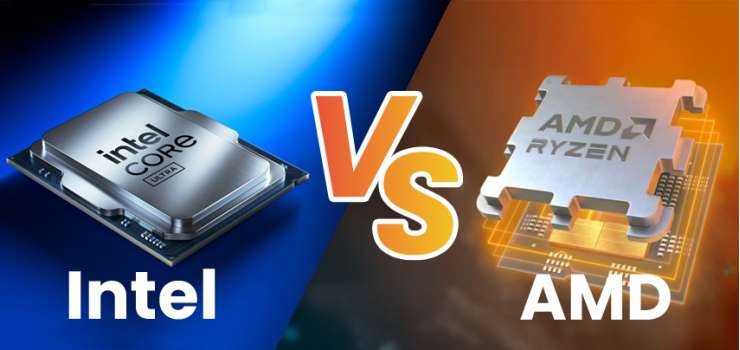
Are you confused because everyone says the "CPU is the brain" of your computer, but then you have to choose between two different brains:
It feels like you are being forced to pick a favorite football team, and you don't even know the rules of the game!
This confusion is completely normal. For years, the battle between Ryzen vs Intel has been the biggest and most complicated question in the PC world, especially for people in Bangladesh who want the best value and performance.
You might worry about making the wrong choice and ending up with a PC that is either too slow or that overheats in our summer weather.
Stop worrying!
You have landed on a guide that is your ultimate, simple Intel vs AMD CPU comparison. We will break down this complex decision into easy steps, showing you exactly which chip is the champion for gaming, which one is better for work, and which one will save you the most money in the long run.
Getting Started
Choosing the right CPU (Central Processing Unit) is the single most important decision when building or buying a new PC.
Consider the CPU as the main engine of your car.
If the engine is weak, nothing else matters!
When comparing AMD vs Intel, both companies make amazing processors. However, they use different technologies and focus on other strengths.
Intel, with its Core i series (i5, i7, i9), often emphasizes raw speed for quick tasks, while AMD, with its Ryzen series (Ryzen 5, 7, 9), often emphasizes handling many tasks simultaneously.
The key to answering which CPU should I choose lies in matching the chip's core strengths to your specific daily needs.
Let’s plunge into the battleground between gaming and productivity.
Gaming Performance: Which CPU Gives Me the Highest FPS?
If you are building a gaming PC, your ultimate goal is smooth frame rates (FPS, or frames per second). The higher the FPS, the smoother the game looks and feels. When considering Intel vs AMD for gaming, both sides offer incredibly fast chips.
Does AMD’s 3D V-Cache Technology Win the Gaming Crown?
Yes, for many competitive gamers, it does!
AMD has developed a special technology called 3D V Cache, which essentially stacks extra memory right on top of the CPU chip.
It is like a professional chef having all his tools and spices right next to his cutting board instead of having to walk across the kitchen.
This massive boost in accessible memory allows Ryzen chips like the Ryzen 7 7800X3D to process game data faster than almost anything else available.
It makes the specialized AMD Ryzen chips arguably the best CPU for gaming, AMD or Intel, in pure, unadulterated performance tests in 2025.
How Do CPU Choices Affect Frame Rates at 1080p, 1440p, and 4K?
It is where your monitor resolution plays a massive role in your decision.
1080p Gaming: At this lower resolution, CPU performance matters most. The CPU is working hard to tell the graphics card (GPU) what to draw, so a high-clock-speed Intel chip or an AMD 3D V Cache chip will give you the highest FPS.
4K Gaming: At this high resolution, the burden shifts mostly to the GPU. The graphics card is doing the heavy work of rendering millions of pixels. In this case, the difference between an equivalent Ryzen 5 and an Intel i5, or between a Ryzen 7 and an Intel i7, becomes very small.
The takeaway?
If you are only gaming on a budget 4K monitor, you can save money on the CPU and put it toward a better GPU. If you play competitive games on a fast 1080p or 1440p monitor (144Hz or higher), invest in the best gaming CPU you can find, which is often an AMD X3D chip.
Productivity & Content Creation: Which Chip is Better for Work?
If you use your PC for making money, whether through video editing, 3D rendering, programming, or running large Excel sheets, your priority shifts from high FPS to multi-core performance.
Do I Need the Highest Core Counts for Video Editing and Rendering?
Absolutely!
Video editing and 3D rendering are what we call "multi-threaded" tasks.
Imagine a team of people pushing a heavy box. A CPU with a high core count is like having more strong people pushing that box.
When comparing the flagship Ryzen 9 vs Intel i9 chips, AMD often historically offered slightly more cores (e.g., 16 cores vs. 24 cores on the competing Intel chip, though the core types differ).
These higher-core-count chips excel at tasks that can utilize all those cores at once, making them often superior to Intel vs. AMD for content creation, where the work takes hours.
If you are a professional and need your work completed as quickly as possible, always choose the processor with the highest available core count within your budget.
Is Intel’s Hybrid Architecture Faster for Everyday Multi-tasking (P-cores/E-cores)?
Yes, Intel has created a clever hybrid architecture (available in their 12th Gen and newer chips) that uses two types of cores:
P cores (Performance cores): These are powerful, high-performance cores designed for single, demanding tasks (such as running a game or running heavy software).
E cores (Efficiency cores): These are smaller cores designed to handle background tasks (like checking email, running antivirus, or updating Windows) very efficiently.
This separation of duties makes Intel chips incredibly fast for everyday, real-world multitasking.
If you constantly have 10 browser tabs open, stream music, and switch between Zoom and Word documents, Intel's design delivers incredibly snappy responsiveness.
Therefore, for most standard office and student productivity use cases, Intel’s current hybrid architecture is often the winner.
Price, Platform, & Value: Which CPU Saves Me the Most Money?
When buying a CPU in Dhaka, you are buying into an entire "platform."
It includes the Motherboard (where the CPU sits) and the RAM. It is where the actual cost and long-term value of the AMD vs Intel decision becomes clear.
This is where the actual cost and long-term value of the AMD vs Intel decision become clear.
Does the Initial CPU Price or Motherboard Cost Matter More?
Both matter, but the Motherboard cost can be the biggest hidden expense!
Intel Motherboards (LGA 1700 / LGA 1851): Historically, the latest Intel motherboards can be pretty expensive, especially the high-end Z series boards you need for overclocking. While Intel offers access to slightly older, cheaper motherboards, these may limit your future upgrade options.
AMD Motherboards (AM5): While the initial cost of a mid-range AM5 motherboard might be slightly higher than an equivalent Intel one, the long-term value is better because of AMD’s platform commitment.
Which Platform Offers Better Future Proofing (AMD AM5 vs. Intel LGA1851)?
It is one of the strongest arguments for choosing AMD right now.
AMD has publicly stated that it will use its current AM5 platform for many years to come. If you buy a Ryzen 5 chip today, you could upgrade to a much faster Ryzen 9 chip three or four years from now without having to buy a brand new motherboard.
Intel, on the other hand, often changes its CPU socket (e.g., from LGA 1700 to LGA 1851) every one or two generations.
Which means if you want to install a new, powerful Intel CPU three years from now, you will almost certainly have to buy a brand new motherboard, too.
It makes AMD the clear champion for future-proofing AMD vs Intel for budget-conscious consumers.
This is a critical factor in the CPU price-to-performance ratio over time.
Power & Thermals: How Much Cooling Do I Really Need?
If you live in a warm climate like Bangladesh, AMD vs Intel power consumption and heat are major concerns.
A hotter chip means more noise, more power bills, and potentially slower performance.
Is AMD or Intel More Power Efficient Under Full Load?
Generally speaking, AMD Ryzen mid-range processors tend to run cooler and be more power-efficient than their Intel counterparts when running high-demand tasks.
It is not always the case, but AMD chips often deliver fantastic performance for the power they use.
Do Intel's High-End Chips Require Expensive Liquid Coolers?
When looking at the top end of the market (like the Core i9), yes, they often do.
Intel chips are designed to draw a lot of power to achieve their top speeds (a higher wattage). To manage this heat, especially in a desktop environment, you must invest in a large, high-quality air cooler or, more commonly, an expensive AIO (All-in-One) liquid cooler.
AMD’s high-end chips also run hot, but they generally manage their heat better at stock settings. If you want a top-tier CPU but want to save money on complex cooling solutions, you should carefully research the thermal demands of the high-end Ryzen 9 vs the Intel i9 you are considering.
Lower power consumption directly translates into lower operating costs and a quieter PC in your home.
Which CPU Should I Ultimately Choose?
After this comprehensive Intel vs AMD CPU comparison, the answer to which CPU should I choose is simple: it depends entirely on your main task.
Choose AMD if: You are building a pure gaming machine (especially the X3D chips), or if you prioritize long-term platform value and want to save money on future upgrades by staying on the AM5 platform. AMD is excellent for processor comparisons, gaming vs. productivity, and when the scales tip towards pure gaming.
Choose Intel if: You prioritize snappy, responsive everyday multi-tasking and fast single-core vs multi-core performance in common applications, or if you are focused on getting the fastest possible speed for a specific productivity task today, regardless of future upgrade costs.
Both platforms offer impressive desktop specs. Now that you know the rules, you can make the right choice for your budget and needs here in Bangladesh!
Frequently Asked Questions (FAQ)
Is AMD or Intel better for pure gaming performance in 2025?
Generally, AMD's specialized X3D chips (like the Ryzen 7 7800X3D) currently hold the crown for the highest raw FPS in many competitive games, particularly at 1080p and 1440p resolutions. They are the go-to choice for the best gaming CPU, whether AMD or Intel.
Which brand offers better value for the money?
AMD often offers a better overall CPU price-to-performance ratio in the long term because of its committed AM5 platform. While the chips themselves are competitively priced against Intel's Core series, AMD's motherboards give you a much better path for upgrading your CPU later without needing to buy a new motherboard, saving you significant money down the road.
Which platform provides a better upgrade path and future-proofing?
AMD’s AM5 platform offers the best future-proofing AMD vs Intel. AMD has committed to using the AM5 socket for several years, meaning buyers today will have access to newer Ryzen generations without replacing their motherboard. Intel typically changes its socket more frequently.
Does Intel or AMD run cooler and use less power?
In the mid-range, AMD Ryzen chips often have better power efficiency, allowing them to run slightly cooler than their direct Intel competitors. However, at the very high end, both the Ryzen 9 vs Intel i9 chips run very hot and require robust, often expensive, cooling solutions like liquid coolers to perform optimally.
Which CPU is better for demanding creative work like video editing or 3D rendering?
Processors from both brands are excellent, but you should prioritize the processor with the highest available core count in your budget. Both the Ryzen 9 vs Intel i9 chips offer extremely high core counts, giving you fantastic Intel vs AMD for content creation performance for heavy multi-threaded tasks.
Can I use an AMD CPU with an Intel motherboard (or vice versa)?
No. AMD CPUs use the AM5 socket, and Intel CPUs use LGA 1700 or LGA 1851. The sockets are physically different and are not compatible with each other. You must choose your motherboard based on the CPU brand you choose.





-330x240.webp)



Comments
There are no comments for this Article.