





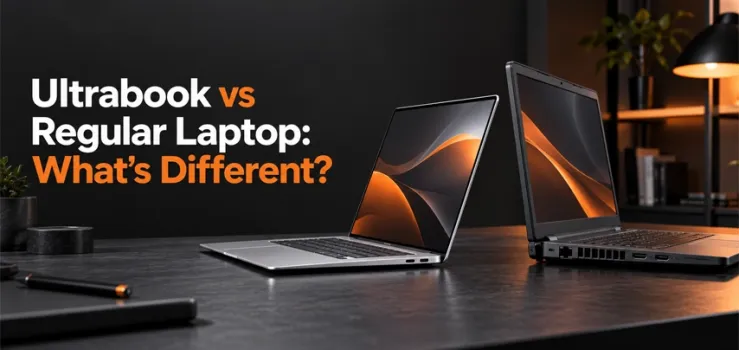
Ultrabook vs. regular laptop is one of the most common questions when buying a laptop in Bangladesh. An ultrabook is a thin, light laptop that typically weighs between 1.0 and 1.5 kg, runs on power-efficient processors like Intel Core Ultra or AMD Ryzen AI series, and delivers 10 to 20 hours of real-world battery life. A regular laptop is thicker and heavier, usually 1.8 to 2.8 kg, but gives you more choice in processor tier, the option to add a dedicated GPU for gaming or creative work, and better upgradeability because the RAM and storage are often accessible.
Not every thin laptop is an ultrabook. The term 'ultrabook' was originally an Intel-certified category with strict rules about weight, thickness, SSD storage, and battery life.
Today, retailers in Bangladesh use 'ultrabook' more loosely to refer to any slim, premium laptop.
Intel Evo is Intel's current successor to the ultrabook specification, a verified platform standard with certified benchmarks for battery life, responsiveness, and connectivity.
An Intel Evo laptop meets tighter real-world performance standards than a laptop simply marketed as 'ultrabook' by a retailer.
Ultrabook prices in Bangladesh start at around ৳80,000 for entry-level slim laptops and go up to ৳2,00,000 and above for certified premium models. Regular laptops start from ৳30,000.
The right choice depends on your daily routine, not the label on the box. This article answers every question a Bangladeshi buyer has when choosing between the two categories, including weight, battery life, performance, gaming suitability, upgradeability, and budget.
What Separates an Ultrabook from a Regular Laptop in 2026?
The difference between an ultrabook and a regular laptop comes down to portability versus flexibility.
An ultrabook is engineered to be thin, light, and power-efficient above all else. A regular laptop is engineered to provide more processing power, more GPU options, more ports, and more room for upgrades over time. Neither is the better laptop. They are different devices built for different users.
If you carry your laptop to university or work every day and rarely sit at a desk for more than a few hours at a time, the weight difference alone makes an ultrabook worth considering.
If you run demanding software or games, or want to upgrade your RAM in a year, a regular laptop is better suited to you.
The ultrabook price in Bangladesh reflects that design premium, and understanding what you are paying for makes the decision clear.
What 'Ultrabook' Actually Means Today?
An ultrabook is a laptop that prioritizes thinness, light weight, battery life, and fast storage over raw processing power or expandability.
The term was originally a formal Intel specification introduced in 2011, requiring specific weight limits (under 1.4 kg for 13-inch screens), an SSD as the primary drive, a minimum battery life standard, and a fast resume from sleep.
Those formal rules no longer apply in the same way, but the ultrabook meaning in the laptop market has stuck to a slim, premium, productivity-focused portable machine.
Today in Bangladesh, 'ultrabook' is used as a broad commercial category rather than a certified specification.
When a retailer lists a laptop as an ultrabook, they usually mean it is thin, light, and built for portability. Whether that laptop meets any technical definition of ultrabook varies.
Not every thin laptop is an ultrabook, and not every ultrabook is thin in the same way. The defining features that still hold across the category are weight under 1.5 kg, thickness under 18 mm, SSD-only storage, and battery life above 8 hours in real-world mixed use.
Ultrabook vs Intel Evo: Are They the Same Thing?
No, they are not the same, though they are closely related.
Intel Evo is Intel's current verified laptop platform standard, replacing the original Ultrabook specification.
An Intel Evo laptop must pass a series of standardized tests that cover real-world battery life (at least 9 hours on a 1080p display), instant wake-from-sleep under one second, fast charging (4 hours of use from a 30-minute charge), connectivity standards (Thunderbolt 4 or higher, Wi-Fi 6E or better), and responsive performance across productivity workloads.
The key difference is verification. Any laptop can be marketed as an 'ultrabook' by a retailer. An Intel Evo laptop has been independently tested by Intel against those specific benchmarks and must meet all of them to earn certification.
Consider it the ultrabook category's stricter, certified tier. All Intel Evo laptops are ultrabooks by every meaningful definition, but not all ultrabooks are Intel Evo certified.
For buyers who want the assurance of tested real-world performance rather than marketing language, Intel Evo certification is worth looking for.
The MSI Prestige 14 AI Evo is a good example of a certified Intel Evo laptop available in Bangladesh.
Ultrabook vs Regular Laptop: The Real Differences
The spec sheet alone does not tell you what using each type actually feels like. Here is a real-world breakdown of the meaningful differences between the two categories.
Weight and Thickness
If you carry your laptop to university or work every day, the weight difference matters more than most buyers expect before they experience it.
An ultrabook at 1.2 kg feels noticeably lighter than a regular 15.6-inch laptop at 2.2 kg after an hour of walking, especially in Bangladesh's heat.
Over five days of commuting, that difference is real and physical. An ultrabook also fits into more bags without the bulk that a regular laptop demands.
A thickness under 18 mm means it slides into a backpack sleeve that a regular 28 mm laptop cannot fit into.
Battery Life
Battery life is where ultrabooks have the clearest advantage over regular laptops.
A regular laptop at full-screen brightness, with office work and a few browser tabs running, typically lasts 4 to 7 hours. An ultrabook with the same workload regularly reaches 10 to 15 hours. Intel Evo-certified ultrabooks guarantee at least 9 hours of real-world use under tested conditions.
For a student who attends five back-to-back lectures without a socket nearby, or a freelancer who works from cafes, that difference is the reason to choose an ultrabook over everything else.
Why do ultrabooks last longer on battery? The processors inside them are designed for efficiency first.
Intel Core Ultra and AMD Ryzen AI series chips use less power to perform the same tasks as a standard laptop chip because they have dedicated cores for low-power background tasks and a more efficient architecture for sustained workloads.
Performance and Graphics
Ultrabooks are powerful enough for everyday professional work, but they are not the right choice for heavy GPU-dependent tasks.
Writing, spreadsheets, video calls, coding in most languages, web development, running multiple virtual machines on modest workloads, and photo editing in Lightroom all run well on an ultrabook with 16GB RAM.
4K video editing in DaVinci Resolve, 3D rendering in Blender, and running large machine learning models locally will feel the limitations of integrated graphics and thermals designed for thin chassis.
Regular laptops with a dedicated NVIDIA RTX or AMD Radeon GPU handle those workflows without constraint.
Are ultrabooks good for programming? Yes, for most programming work.
Writing and running code, using Docker containers on moderate workloads, running a development server alongside your editor, and joining video calls simultaneously is well within what a well-specced ultrabook handles comfortably.
Developers who compile extremely large codebases or run multiple virtual machines simultaneously will see faster results from a regular laptop with more thermal headroom.
Build Quality and Ports
Ultrabooks are almost always built from better materials than regular laptops at the same or lower prices.
Aluminum-magnesium alloy chassis are standard on most ultrabooks. They resist flex, handle being opened and closed thousands of times without hinge wear, and feel solid rather than hollow.
Many budget regular laptops use plastic bodies that creak after six months of use. On ports, ultrabooks sacrifice physical port count for a thinner design.
Expect two to three USB-C Thunderbolt ports, sometimes one USB-A port, and often no full-size HDMI port.
Regular laptops typically include a full-size HDMI port, multiple USB-A ports, and sometimes an SD card reader.
Upgradeability and Repairability
This is the most significant long-term trade-off between the two categories, and it clearly favors regular laptops.
Most ultrabooks solder the RAM directly to the motherboard. You cannot add more later. The RAM you choose at the time of purchase is the RAM you have for the life of the laptop.
A 16 GB ultrabook today cannot become an 8 GB laptop in two years. Many ultrabooks also restrict SSD access, requiring disassembly that, in practice, voids the warranty.
Regular mid-range laptops typically have accessible RAM slots and a replaceable M.2 SSD.
Ultrabook repair costs in Bangladesh are also higher than those for regular laptops. When an ultrabook motherboard fails, the integrated RAM means the entire board must be replaced rather than just the component.
Authorized service centers for ultrabook brands in Bangladesh are available but handle fewer units, so parts take longer to arrive than for mainstream regular laptop models.
Ultrabook battery replacement in Bangladesh is also more involved because the battery is often glued rather than screwed.
Ultrabook vs Regular Laptop Price in Bangladesh (2026)
Understanding ultrabook price in Bangladesh requires understanding what the premium actually buys you.
An ultrabook does not just cost more because of the brand name. It costs more because the engineering required to fit a powerful processor, a long-lasting battery, and a quality chassis into a 14 mm-thick body is genuinely more expensive to produce than a regular laptop chassis.
The question is whether that engineering solves a real problem in your daily life.
At ৳90,000 to ৳1,30,000, you are choosing between an ultrabook that lasts 12 to 15 hours on battery and a regular laptop that gives you a dedicated GPU for gaming or creative work. That is not a value comparison. It is a use-case comparison.
A freelancer who works from multiple locations gets more real value from the ultrabook battery life. A developer who runs local Docker environments and games on weekends gets more real value from the expandability of a regular laptop.
The full range of laptop prices in Bangladesh across both categories is available at EERNA, with verified specs and an official warranty.
What does an ultrabook's premium actually include? You are paying for a lighter chassis that reduces daily carry fatigue, battery life that covers a full day without a charger, a display that is typically brighter and more color-accurate than budget regular laptops, a keyboard with better key travel than most budget machines, and, in the case of Intel Evo certified models, guaranteed real-world performance benchmarks that marketing-only claims cannot provide.
For buyers who find the Best PC shop in Bangladesh, these details can be verified at the point of sale.
Who Should Actually Buy an Ultrabook?
Buy an ultrabook if your laptop travels with you most days and battery life affects your actual work output.
That profile covers university students who carry their laptops between lectures and library sessions, office professionals who move between meetings and work from different locations, freelancers and remote workers who depend on their laptops for 8 or more hours daily, and frequent travelers who cannot always guarantee access to a power outlet on time.
University students on the go: An ultrabook at 1.2 to 1.4 kg is significantly lighter to carry across campus every day versus a regular 15.6-inch laptop at 2.2 kg. Battery life that covers all lectures without charging is a genuine daily benefit.
Office professionals who attend meetings or travel: Thin enough for a work bag, battery enough for a full day of documents and video calls without hunting for a socket.
Freelancers and remote workers: Long-session battery life, a reliable webcam, fast SSD for tool startup, and a keyboard that handles thousands of keystrokes daily without wearing out quickly.
Content creators who travel: If you edit photos on the road and don't need 4K video editing, an ultrabook with 16GB of RAM handles Lightroom and basic Premiere Pro work without issue.
Anyone who prioritizes a laptop that doesn't feel heavy after two hours of carrying: The physical difference between 1.2 kg and 2.3 kg is immediately noticeable. If portability affects your comfort, an ultrabook is the solution.
Who Should Buy a Regular Laptop Instead?
A regular laptop is the right choice when your work demands a dedicated GPU, when you want to upgrade RAM later, or when your budget is under ৳80,000.
None of these are compromises. They are accurate matches between the tool and the task.
Students on a budget: Under ৳60,000, regular laptops offer far more capable hardware than slim laptops. More processing power, a larger display, and often an SSD plus more RAM at the same price.
Gamers: Ultrabooks cannot run AAA games at playable frame rates. A regular laptop with a dedicated NVIDIA RTX 4050 or above is the only viable choice for gaming in Bangladesh.
Developers who want to upgrade RAM: If you plan to go from 8GB to 16GB or 32GB in a year, a regular laptop with accessible RAM slots is the better long-term investment.
Video editors and 3D designers: 4K editing in DaVinci Resolve, 3D rendering in Blender or AutoCAD, and running Premiere Pro on complex timelines benefit significantly from a dedicated GPU, which most ultrabooks lack.
Buyers who primarily work from one desk: If you rarely move your laptop, the portability premium of an ultrabook gives you nothing. The same money buys better raw performance in a regular laptop.
Ultrabook or Regular Laptop: Decision by Use Case
Use this table to match your primary use case to the right category.
Common Misconceptions About Ultrabooks
Several beliefs about ultrabooks circulate in Bangladesh's laptop market that are either outdated or simply not accurate. Clearing them up prevents buyers from making decisions based on wrong assumptions.
Are Ultrabooks Less Powerful?
No, not for everyday professional workloads.
Modern ultrabooks run Intel Core Ultra 5 and Core Ultra 7 processors with 10 or more cores. They handle office work, web development, coding, and video calls without any noticeable slowdown.
The limitation is sustained GPU-heavy workloads, not everyday processing tasks. An ultrabook running Microsoft Office, a browser with 20 tabs, and a video call simultaneously will not slow down or overheat.
Do Ultrabooks Overheat?
Less than regular laptops, not more.
The processors inside ultrabooks are designed for low thermal output. They produce less heat at sustained workloads than a full-voltage processor in a regular laptop.
The thin chassis means that when an ultrabook does get warm, there is less space for heat to dissipate, so fans run more noticeably. But thermal throttling under normal productivity workloads is rare on a well-designed ultrabook.
Are All Thin Laptops Ultrabooks?
No. A thin laptop and an ultrabook are not automatically the same thing.
A budget-slim laptop at ৳55,000 may be thin but run on a lower-tier processor, with a standard-efficiency chip, shorter battery life, and a plastic body.
Calling it an ultrabook is a marketing choice, not a technical description. The meaningful ultrabook characteristics are low weight, a high-efficiency processor, a battery life of over 10 hours, SSD-only storage, and premium build quality.
All of those together make an ultrabook.
Are Ultrabooks Only for Business Users?
No, and this misconception stops students from buying a laptop that would genuinely serve them better.
University students who carry their laptops across campus every day and attend lectures from morning to afternoon without guaranteed access to power sockets are exactly the profile an ultrabook suits.
The business label comes from ultrabook marketing, not from any technical restriction on who can use them.
Are Ultrabooks Overpriced?
They are priced higher because the engineering genuinely costs more, not because of brand inflation alone.
Fitting a long-battery, high-efficiency chip into a 14 mm aluminum chassis requires tighter tolerances, more expensive components, and greater manufacturing precision than a standard plastic laptop shell.
Whether that premium is worth it for you depends on whether you use the portability every day. If you do, it is not overpriced. If you work from one desk, it probably is not the right tool for you at that price.
Final Verdict: Which One Should You Choose?
Choose an ultrabook if portability and battery life are the two things that most directly affect your daily work.
Choose a regular laptop if raw performance, a dedicated GPU, or the ability to upgrade your RAM in a year matters more to you.
Here is the decision framework in four questions.
Do you carry your laptop most days and work away from a desk for more than 4 hours? Yes means ultrabook. No means evaluate further.
Do you game, run 3D software, or edit 4K video regularly? Yes means a regular laptop with a dedicated GPU. No means continue.
Do you plan to upgrade RAM in the next two years? Yes means a regular laptop. No means continue.
Is your budget under ৳80,000? Yes means a regular laptop is the only realistic option. No means an ultrabook is on the table.
Whichever category you land in, confirm that the laptop you are buying has an official Bangladesh warranty rather than an international or shop warranty, since the service implications are significantly different.
The distinction between official and grey-market laptops in Bangladesh affects every laptop purchase, regardless of category.
If your answers point toward an ultrabook, the current range of available models in Bangladesh features Intel Core Ultra 5 and Ultra 7 processors and offers real-world battery life of 12 to 18 hours.
If your answers point toward a regular laptop, the range from ৳35,000 to ৳1,50,000 includes options for students, developers, gamers, and creators across every major brand.
Frequently Asked Questions on Ultrabook vs Regular Laptop
What is the actual difference between an ultrabook and a regular laptop?
An ultrabook weighs 1.0 to 1.5 kg, is under 18 mm thick, uses a power-efficient processor, runs on SSD-only storage, and delivers 10 to 20 hours of battery life. A regular laptop is heavier and thicker but offers more GPU options, upgradeable RAM, and a lower starting price.
Is 'Ultrabook' still an official Intel certification?
No. Intel discontinued the formal Ultrabook certification around 2014 and replaced it with Intel Evo, a stricter verified platform standard. 'Ultrabook' is now a broad commercial category used by retailers to describe slim, premium laptops regardless of Intel certification status.
What is Intel Evo, and is it the same as an ultrabook?
Intel Evo is Intel's verified laptop platform standard, replacing the original Ultrabook certification. An Intel Evo laptop must pass tested benchmarks for battery life, instant wake from sleep, fast charging, and connectivity standards. All Intel Evo laptops qualify as ultrabooks, but not all ultrabooks are Intel Evo certified. An example of a certified Intel Evo model available in Bangladesh is the MSI Prestige 14 AI Evo.
Are ultrabooks good for gaming or CAD software?
Ultrabooks are not suitable for AAA gaming because they rely solely on integrated graphics. Light titles and browser games run acceptably. CAD software like AutoCAD runs at a basic level but is limited by the integrated GPU's performance on complex models. Regular laptops with dedicated GPUs are the right choice for both gaming and professional CAD work.
Are ultrabooks worth the extra price compared to a regular laptop?
Yes, if you use the portability every day. If you travel frequently, carry your laptop between locations, or need a full workday on battery without charging, the premium is justified by real daily utility. If you work primarily from one desk, the portability premium offers little benefit.
Can you upgrade the RAM or storage on an ultrabook?
RAM is almost always soldered to the motherboard on ultrabooks and cannot be upgraded after purchase. SSD access varies by model. Some ultrabooks have an accessible M.2 slot under the back panel. Others require full disassembly. Always check the specific model's service manual before purchase if future upgradeability matters to your decision.
Is an ultrabook or a regular laptop better for university students in Bangladesh?
It depends on the student's budget and daily routine. Students who carry their laptops across campus all day and need all-day battery life benefit from an ultrabook. Students on a tight budget under ৳60,000, or who game or run demanding software, get better value from a regular laptop.
Do all thin, lightweight laptops count as ultrabooks?
No. Thinness alone does not make a laptop an ultrabook. A genuine ultrabook combines low weight (under 1.5 kg), a high-efficiency processor, SSD-only storage, long battery life (8 to 10+ hours in real-world use), and typically a premium build material. Budget thin laptops may be slim but lack the battery life, processor efficiency, or build quality that defines the category.





-330x240.webp)



Comments
There are no comments for this Article.