





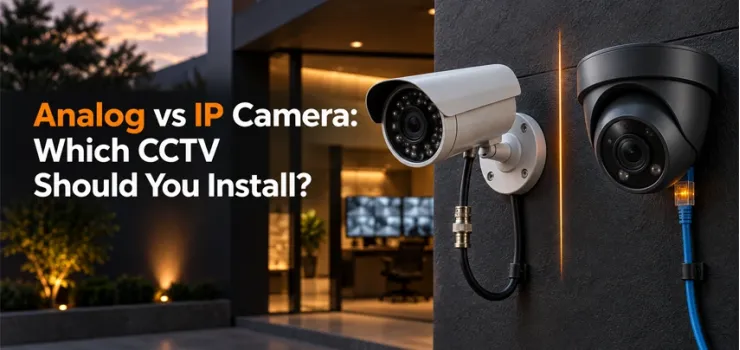
Analog vs IP Camera? It is the most important decision in any CCTV installation. Analog cameras send video over a coaxial cable to a DVR (Digital Video Recorder). IP cameras send compressed digital data over an Ethernet cable to an NVR (Network Video Recorder). Both systems can record high-resolution footage and be viewed remotely on a phone. The key differences are image quality ceiling, smart feature availability, cabling type, cost, and how easy each system is to expand later.
Modern analog cameras are not the blurry systems from ten years ago. Today's HD-over-Coax cameras using AHD, TVI, or CVI technology record at 2MP, 4MP, and even 8MP over the same coaxial cable older analog systems used. They are a strong option if you have existing coaxial wiring and a tighter budget.
IP cameras go further. They support resolutions up to 4K and beyond, smarter detection features such as person and vehicle alerts, simpler wiring via PoE (Power over Ethernet), and easier future expansion.
For a home or apartment in Bangladesh, a 4-camera analog HD package costs around ৳15,000 to ৳25,000 for the cameras and DVR.
A 4-camera IP system starts at around ৳25,000 to ৳45,000. The right choice depends on your wiring, budget, and how much detail and smart features you actually need.
Choose a CCTV camera based on your specific property, not on which technology sounds newer or more modern.
Which Is Better: Analog or IP Camera for CCTV?
The analog vs IP camera question comes up every time someone installs or upgrades a CCTV system in Bangladesh.
Both technologies work. Both record video. Both can be monitored from your phone. The right answer depends on what you already have installed, how much you want to spend, and what level of image detail and smart features matter to you.
Let’s walk through every meaningful difference so you can make a decision based on your actual property, not on marketing language.
Whether you are setting up CCTV for the first time or replacing an old system, the full range of cameras and packages from a trusted gadget store like EERNA offers both technologies with an official warranty and installation support.
Analog vs IP Camera: The Basic Difference
An analog camera converts the video it sees into an electrical signal and sends it down a coaxial cable to a DVR. The DVR receives that signal, converts it to digital, and saves it to a hard drive. Everything happens in the recorder. The camera itself is simple.
An IP camera is essentially a small computer inside a camera body. It captures video, compresses it into a digital file, and sends that file over an Ethernet cable to an NVR.
The camera does the hard work. The NVR just receives and stores the data. Because the camera handles compression and encoding, it can also run smart detection features like person alerts and motion zones without needing the recorder to do that processing.
The practical implication of this difference is simple. IP cameras offer more features and flexibility, but they cost a bit more. Analog cameras are simpler to manage and cheaper to start, especially if you already have coaxial cables installed.
Where HD-over-Coax (TVI, CVI, AHD) Fits In
HD-over-Coax is the modern version of analog CCTV, and it is not what most people picture when they hear 'analog camera.'
The old analog systems from 2010 recorded at a resolution of 480 lines. Today's HD-over-Coax systems using AHD (Analog High Definition), TVI (Transport Video Interface), or CVI (Composite Video Interface) technology record at 1080p, 4MP, 4K, and higher resolutions over the same coaxial cable.
AHD, TVI, and CVI are three competing HD-over-Coax standards from different manufacturers. They are not compatible with each other.
A TVI camera requires a TVI-compatible DVR. A CVI camera requires a CVI DVR. Most modern DVRs sold in Bangladesh are XVRs or hybrid DVRs that support all three standards simultaneously.
If you are buying a new system, it means you can choose any HD-over-Coax camera brand without worrying about which specific standard it uses, as long as your DVR supports all three, which most current models do.
HD-over-Coax cameras are still analog cameras in the technical sense. They send a signal over coaxial cable, not data packets over Ethernet.
But they are not low-resolution anymore. A 4MP TVI camera records more detail than a 2MP IP camera at the same price point.
The label called 'analog' can be misleading because it makes buyers think they are choosing between old blurry footage and sharp IP footage.
That is not the real trade-off in 2026.
Video Quality and Resolution
For home and small business use in Bangladesh, both technologies are available at 2MP (1080p), 4MP (2K), and 5MP.
IP cameras reach higher resolution ceilings, with 8MP (4K) and higher options more widely available than in analog systems.
If you need to zoom in on footage and read a number plate from 15 meters away or identify a face in a wide shot, the higher-resolution ceiling of IP cameras gives you more room to work with.
The more important quality factor for conditions in Bangladesh is night vision. Both analog and IP cameras include infrared LEDs for night recording.
IP cameras with color night vision, using wide-aperture lenses and full-color sensors, can record detailed color footage in very low light without infrared.
It is a meaningful advantage for identifying clothing color, vehicle color, and other color-dependent details in overnight incidents.
A common misconception
A higher megapixel number on a camera does not automatically mean better footage. Lens quality, sensor size, and in-camera processing matter as much as resolution.
A well-made 2MP IP camera with a quality lens and strong processing often produces more usable footage than a cheap 5MP camera with a poor sensor.
Cabling and Installation
Analog cameras use coaxial cable, typically RG59 or RG6. IP cameras use Ethernet cable, typically Cat5e or Cat6. These cable types are physically different and are not interchangeable.
Coaxial cable is a thick, stiff cable with a single central conductor surrounded by shielding. It carries the analog video signal from the camera to the DVR.
An IP camera cable is the same flat Ethernet cable you use for your internet router. Cat6 cable carries both the data signal and, with a PoE switch or NVR, the power to run the camera.
It is one of the biggest practical advantages of IP systems because one cable per camera handles everything. No separate power outlet near each camera. No extra wiring.
Can You Reuse Existing Coaxial Wiring?
If you already have coaxial cable installed in your walls, you have two options.
The first is to use an HD-over-Coax camera system that runs over the existing coaxial cable. It is the simplest and cheapest approach if your existing wiring is in good condition. A TVI or AHD camera with a compatible DVR will use your existing coax without any rewiring.
The second option is to convert coaxial cable to work with IP cameras using a coaxial-to-IP converter, also called a coax-to-Cat6 or video balun converter.
These devices let IP cameras run over existing coaxial cable. The result is slightly less efficient than native Cat6 wiring, but it makes the conversion possible without full rewiring.
If your coaxial cable runs are accessible and in good condition, this approach can save significant installation costs when upgrading an old system to IP cameras.
If you are starting from scratch with no existing wiring, Cat6 cable is the better choice. It supports IP cameras, PoE power delivery, future network expansion, and is easier to manage long-term than coaxial cable.
Storage: DVR vs NVR
The recorder is where your CCTV footage is stored, and the type of recorder determines which cameras it can accept.
A DVR (Digital Video Recorder) accepts analog and HD-over-Coax camera inputs via coaxial cable.
An NVR (Network Video Recorder) accepts IP camera inputs via Ethernet cable. They both perform the same job, recording and storing footage, but they use different camera technologies.
A hybrid DVR, sometimes called an XVR, accepts both coaxial camera inputs and IP camera inputs. It is the right recorder for a mixed system or for someone gradually upgrading from analog to IP.
Most quality DVRs sold in Bangladesh today are hybrid XVRs, which remove the need to replace your recorder immediately when you want to add a few IP cameras to an existing analog system.
How much storage do you need? Motion detection recording helps, but planning for continuous recording is safer.
Here is an updated storage guide for Bangladesh buyers:
These figures assume motion detection recording for 12 hours per day and continuous recording for 12 hours.
Full continuous recording 24 hours a day requires roughly double these figures. A 4TB hard drive in Bangladesh currently costs approximately ৳8,000 to ৳23,000, depending on brand and speed rating.
Remote Viewing and Smart Features
Both analog and IP systems can be viewed remotely on your phone, but the experience differs significantly between the two.
An analog DVR sends a compressed video stream over your internet connection to your phone. You can see live footage and review recordings. The process works, but the image quality on your phone is typically lower than what IP cameras deliver because the DVR is compressing an already compressed signal.
IP cameras stream directly in their native resolution. When you open the app, you see the full quality of what the camera is recording. IP systems also support smart detection alerts that notify your phone when a person enters a zone, a vehicle enters a driveway, or motion occurs in a specific area. These alerts help you react to events rather than reviewing hours of footage after the fact. You can buy IP camera packages that include a preconfigured remote-access setup as part of the installation.
Does an IP camera need internet to work? No. IP cameras record locally to the NVR without any internet connection.
You only need internet if you want to view the cameras remotely from outside your home or office. The recording continues regardless of whether your internet is working.
Cost Comparison: Analog vs IP in Bangladesh
The upfront cost difference between analog and IP systems in Bangladesh is real but smaller than most buyers expect.
A basic 4-camera 1080p HD-over-Coax package, including a DVR, costs around ৳15,000 to ৳25,000.
A comparable 4-camera 1080p IP system starts at around ৳25,000 to ৳45,000. The difference is roughly 30% to 60% more for IP, depending on brand and features.
Analog 4-camera HD package (cameras, DVR, HDD, basic install): ৳15,000 to ৳30,000
IP 4-camera package (cameras, NVR, HDD, basic install): ৳25,000 to ৳50,000
IP 4-camera package with PoE NVR (no separate power wiring): ৳30,000 to ৳60,000
8-camera analog HD package: ৳30,000 to ৳55,000
8-camera IP package: ৳50,000 to ৳90,000
Installation Cost: DIY vs Professional
Most small home installations in Bangladesh are carried out by the seller's technicians rather than by a separate contractor.
Professional installation, including cable running, camera mounting, DVR setup, and remote access configuration, typically adds ৳3,000 to ৳8,000 for a 4-camera setup depending on the property layout and cable distances.
Larger commercial installations with 16 or more cameras across a multi-floor building can cost ৳15,000 to ৳40,000 for labor alone.
IP camera installation takes marginally longer than analog in terms of network configuration, but the single-cable PoE setup often makes the physical cable running faster.
This is because each IP camera needs only one cable run rather than a power cable plus a coaxial cable.
Which System Should You Actually Install? (By Use Case)
The right CCTV technology depends on your property type, existing infrastructure, budget, and how much technical management you want to do long-term.
Home and Apartment Security
For a typical Bangladesh home or apartment needing 4 to 8 cameras, both technologies work well.
If you are installing for the first time and have no existing coaxial wiring, a 4-camera PoE IP system is the cleaner option.
It got one cable per camera, has a simple network setup, phone app access, and smart motion alerts. If you are replacing an old analog system and the coaxial cables are already in the walls, an HD-over-Coax upgrade using AHD or TVI cameras over existing coaxial cable saves on high rewiring cost with better image quality than the old system.
Apartment buildings in Dhaka with shared corridors, parking areas, and rooftop access are well-served by 4 to 8 IP cameras with night vision and motion alerts.
The ability to receive an instant phone notification when someone enters a stairwell at 2am is a meaningful safety feature that analog systems cannot easily replicate.
Small Shops and Retail Storefronts
For a single shop with 2 to 4 cameras covering the entrance, cash counter, and main floor, analog HD-over-Coax cameras with a DVR are a cost-effective and perfectly functional choice.
The image quality at 2MP or 4MP is sufficient to identify faces and products at normal retail distances. The setup is simple, and the DVR is easy to manage without networking knowledge.
If you want to check your shop cameras on your phone while away or receive alerts when someone enters after hours, an IP camera setup is more suitable.
An analog camera with a DVR can also support remote viewing, but IP cameras deliver a more reliable, higher-quality remote stream with less configuration.
For shops in areas with frequent power cuts, both systems benefit from a UPS (Uninterruptible Power Supply) to keep recording during short outages.
Offices and Larger Commercial Premises
For offices, commercial buildings, warehouses, or any property needing 8 or more cameras, IP CCTV is the better long-term investment.
IP cameras can be placed anywhere with a network point or a long Cat6 cable run, without needing to run coaxial cable back to a central DVR room.
A PoE switch placed on each floor covers all cameras on that floor, with a single cable running back to the NVR.
Larger properties also benefit from IP's scalability. Adding two more cameras to an IP system means adding two camera network connections. Adding cameras to an analog DVR system means you are limited by the DVR's port count.
When the DVR is full, you either need a second DVR or a larger replacement unit. For offices planning to expand over time, IP systems scale more cleanly as you grow.
More security options are available on the market, covering IP-based systems for buildings of different sizes, with packages suited to commercial use.
Upgrading From Analog to IP: What You Need to Know
The most common situation for upgrade buyers in Bangladesh is an existing coaxial cable installation with old low-resolution cameras.
You have three options, and each has a different cost and outcome.
Option 1: Upgrade to HD-over-Coax. Keep your existing coaxial cables and swap old analog cameras for AHD or TVI models paired with a modern XVR. It is the fastest and cheapest path to higher image quality.
Option 2: Use Coaxial-to-IP Converters. Install video baluns at both ends to run IP cameras over existing coaxial wiring. This avoids the full rewiring costs, though performance is slightly below that of native Cat6.
Option 3: Full Rewire with Cat6 & IP System. Replace old coaxial cables with Cat6 wiring, IP cameras, and a PoE NVR or switch. Best for damaged wiring, large system expansions, or achieving maximum performance.
Common Mistakes When Choosing a CCTV System
These are the decisions that buyers in Bangladesh most commonly regret after installation.
Buying on camera count alone.
A 16-camera package with 720p cameras is less useful than an 8-camera package with 2MP cameras.
Fewer cameras with better image quality often serve you better than more cameras with poor detail.
Not planning for storage: Many buyers install cameras and a DVR but choose a hard drive that fills up in 7 days. For a 30-day recording cycle, refer to the storage guide above and choose accordingly.
Choosing cameras without night vision for outdoor locations: In Bangladesh's typical lighting conditions, outdoor cameras without strong infrared night vision produce black or blurry footage in unlit areas. Always confirm the night vision range in meters for any outdoor camera.
Assuming analog means low quality: A modern 4MP AHD camera records significantly more detail than an old 480-line analog camera. The label 'analog' does not mean poor image quality in 2026.
Installing cameras without planning cable routes: Running cables after the cameras are mounted is significantly harder than mounting cameras where your cable routes allow. Plan the cable path first.
Not setting a password on the DVR or NVR: Default passwords on CCTV recorders are widely known. Change the password on any DVR or NVR immediately after installation.
Final Verdict: Analog or IP for Your CCTV System?
There is no single right answer for every buyer. The right system depends on what you already have, what you want to achieve, and what you are willing to spend.
Choose analog HD-over-Coax (AHD, TVI, or CVI) if you have existing coaxial wiring in good condition, your budget is under ৳25,000 for a 4-camera setup, you do not need smart detection alerts, and your property is a home or small shop where 2MP to 4MP image quality is sufficient.
Choose an IP camera if you are doing a new installation from scratch, want smart detection alerts on your phone, plan to expand the system with more cameras later, need 4K resolution or color night vision, or are covering a large commercial property where scalability matters.
Choose a hybrid XVR system if you have existing coaxial wiring but want to add IP cameras in specific locations that require greater detail. A hybrid DVR lets you run both camera types from one recorder.
Whatever direction you choose, the quality of the camera, recorder, and hard drive matters more than the technology label on the box.
A well-chosen analog camera setup will outperform a poorly chosen IP system every time. Spend the same budget on fewer, better cameras with a quality recorder rather than more cameras with a cheap recorder and no storage plan.
Quality always outperforms quantity!
Frequently Asked Questions on Analog Vs. IP Camera
What is the main difference between analog and IP cameras?
Analog cameras send a video signal over coaxial cable to a DVR. IP cameras send compressed digital data over Ethernet cable to an NVR. IP cameras handle their own processing internally and support smart features. Analog cameras are simpler and often cheaper upfront.
Is an IP camera better than analog CCTV?
IP cameras offer higher resolution ceilings, smarter detection features, simpler single-cable PoE wiring, and easier scalability. Analog HD-over-Coax cameras are better if you have existing coaxial wiring, a tighter budget, or simpler recording needs. Neither is universally better.
Can I use my existing analog wiring for an IP camera system?
Yes, with video balun converters that adapt coaxial cable to carry IP camera signals. The signal quality is slightly lower than that of native Cat6 wiring but is good enough for most standard-resolution cameras. This saves significant rewiring cost during an upgrade.
What is the difference between a DVR and an NVR?
A DVR (Digital Video Recorder) receives video signals from analog or HD-over-Coax cameras via coaxial cable. An NVR (Network Video Recorder) receives compressed digital data from IP cameras via Ethernet. Both record and store footage to an internal hard drive.
Are analog cameras cheaper than IP cameras in Bangladesh?
Yes, typically. A basic HD analog camera costs ৳2,000 to ৳4,000 in Bangladesh. A comparable IP camera costs between ৳3,500 and ৳8,000. A complete 4-camera analog package costs roughly 30% to 50% less than a comparable IP package when including a DVR and storage.
Can analog CCTV cameras be viewed remotely on a mobile phone?
Yes. Modern DVRs include remote viewing apps that stream live footage and recordings to your phone over the internet. The stream quality is generally lower than IP camera remote viewing, but it works reliably for basic remote monitoring.
What is HD-over-Coax (TVI, CVI, AHD), and is it analog or IP?
HD-over-Coax cameras, including TVI, CVI, and AHD, are modern analog cameras that transmit high-definition video over coaxial cable. They are technically analog, not IP. They record at 1080p, 4MP, and 4K over existing coaxial wiring, and are far better than the old low-resolution analog systems many buyers still picture.
Which is better for a small shop: analog or IP camera?
For most small shops in Bangladesh with 2 to 4 cameras, analog HD-over-Coax is cost-effective and sufficient. If you want phone alerts when someone enters after hours or when motion is detected at the cash counter, IP cameras are better suited for that level of smart monitoring.




-330x240.webp)




Comments
There are no comments for this Article.