




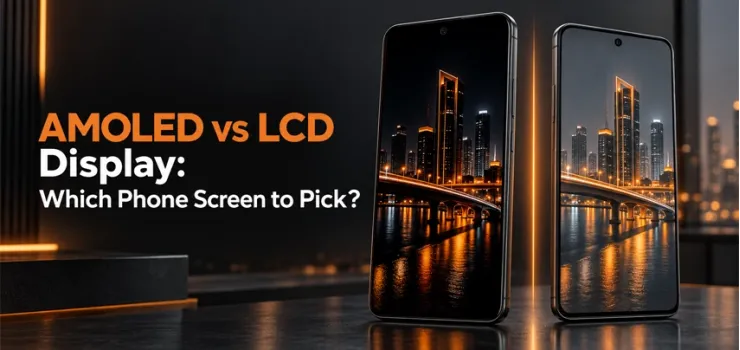
Choose between an AMOLED and an LCD display based on your budget, viewing habits, and visual preferences. You may buy AMOLED if you want deep blacks, punchy colors, and dark-mode battery savings above ৳25,000, or pick LCD if you need a durable, burn-in-free screen on a strict budget under ৳20,000.
Navigating phone specifications can feel overwhelming when deciding between an AMOLED vs LCD display, and every smartphone brand promises the best visual experience.
As a trusted mobile retailer in Bangladesh, we break down how these two screen technologies perform under everyday local conditions, from Dhaka’s intense midday sunlight to late-night video streaming, so you can spend your taka on the display features that matter most to you.
To help you choose the right device, let’s break down the core differences, real-world trade-offs, and current smartphone prices in Bangladesh across both display types.
AMOLED vs LCD: The Basic Difference
The difference comes down to how each screen produces light.
An AMOLED display makes its own light. Every pixel is a tiny organic diode that lights up on its own when electricity passes through it. Turning a pixel off can make it go completely black, no light at all.
An LCD display works differently. It uses a backlight sitting behind a layer of liquid crystals. The crystals twist to let light through or block it. But the backlight itself never fully switches off, even when the screen shows black.
One quick thing worth clearing up is: AMOLED is actually a type of OLED display, not a separate technology. The "AM" stands for Active Matrix, which is just the wiring method that controls each pixel individually. It makes the screen respond faster.
So when you see "OLED" on one phone and "AMOLED" on another, you're usually looking at close cousins, not two totally different things.
Simply, one type emits its own light; the other filters a shared backlight.
What About "Super AMOLED" and "IPS LCD"?
Super AMOLED is the branding used by Samsung phones for AMOLED panels with touch sensors. It is built directly into the display glass rather than as a separate layer on top. It makes the screen thinner and slightly more responsive to touch, but the underlying display tech is the same AMOLED.
IPS LCD (In-Plane Switching LCD) is the most common LCD variant on phones today. It fixes one of the biggest weaknesses of older LCD panels: narrow viewing angles, so colors don't wash out when you tilt the phone.
Most budget and mid-range phones with "LCD" or "TFT LCD" on the spec sheet in Bangladesh are actually running some version of this.
AMOLED vs LCD: Quick Comparison
Choosing between AMOLED and LCD comes down to your priority for picture quality, battery consumption, and overall budget.
Our Hands-On Testing: What We Observed in Real-Life Usage
Having benchmarked dozens of smartphones side-by-side across Dhaka, from bright outdoor testing under the midday sun in Dhanmondi to late-night video streaming, the difference between these two panels was immediately found.
In our side-by-side battery drain tests, running dark mode on a 120Hz AMOLED panel yielded roughly 15% to 20% longer screen-on time during evening YouTube and social media sessions compared to an IPS LCD screen at identical brightness levels.
However, when using light-themed web browsers outdoors, that battery advantage is equalized.
We also noticed that while mid-range AMOLED screens from 2024 onwards easily overcome glare, older budget LCD panels often required cranked-up manual brightness to maintain the same legibility.
Contrast and Black Levels
This is where AMOLED wins clearly. Because AMOLED pixels can switch off completely, black on an AMOLED screen is true black; no light leaks through at all. That's what gives AMOLED phones their "infinite contrast ratio" on spec sheets.
LCD can't do this. Since the backlight always stays on, black on an LCD screen is really a very dark grey. You'll notice this most in a dark room, an AMOLED screen showing a black background almost disappears into the bezel. While an LCD screen has a faint glow around the edges.
In practice, this matters most for movies, photos with dark backgrounds, and nighttime reading.
If you scroll through Instagram or watch YouTube after 11 PM with the lights off, an AMOLED screen is noticeably easier on the eyes.
Battery Life: Does AMOLED Really Save More Power?
Yes, but only in certain conditions, and this is one of the most misunderstood parts of the AMOLED vs LCD battery life debate.
AMOLED saves power because black pixels consume almost no power.
If you use dark mode on WhatsApp, Facebook, or your phone's system theme, an AMOLED screen genuinely sips less battery than an LCD screen doing the same thing. This is a real, measurable effect.
But flip that around: on a bright white webpage or a light-themed app, an AMOLED screen has to power every single pixel individually and can end up using as much or even more power than an equivalent LCD screen with a steady backlight.
LCD's power draw stays fairly constant no matter what's on screen, since the backlight doesn't change based on content.
AMOLED screens save significant battery life when you use dark mode, especially during low-light social media scrolling and video streaming with dark backgrounds.
Subtitles on dark scenes consume very little power. However, these energy savings disappear once you step outdoors. Running bright apps at maximum brightness quickly drains your battery, regardless of the display technology.
Outdoor Visibility and Brightness
LCD used to be better outdoors, but the gap narrowed by 2026.
Because LCD relies on a dedicated backlight, manufacturers can push that backlight very bright without worrying about pixel-level burn-in or heat concentrated in one spot. That's part of why some budget LCD phones still hold up decently under Dhaka's midday sun.
Modern AMOLED has closed most of this gap. Flagship and even mid-range AMOLED phones now hit peak brightness well above 1000 nits. Some Honor mobiles sold in Bangladesh list peak brightness figures of 5000 to 6500 nits in HDR mode, which is more than enough for direct sunlight.
Older or cheaper AMOLED panels from a few years back struggled here, which is where the "AMOLED is dim outdoors" myth comes from. It's largely outdated for phones released from 2024 onward.
Burn-In Risk and Long-Term Durability
Burn-in remains a known weakness of AMOLED displays. It occurs when static elements, such as navigation bars or game HUDs, remain visible at maximum brightness for extended periods, over months or years.
The organic material in those specific areas degrades faster, leaving behind a subtle ghost image. While rare in standard daily use, it poses a genuine risk to users running a single application continuously, such as drivers relying on navigation all day.
In contrast, LCD panels eliminate this risk entirely because their backlights age uniformly across the screen.
A secondary comfort consideration is Pulse Width Modulation (PWM).
Some AMOLED displays rely on rapid flickering to adjust dimming, which can induce eye strain or headaches for sensitive users at low brightness. While 2025–26 flagships counter this with high-frequency PWM or DC dimming, flicker-sensitive buyers should test devices in person before buying.
Ultimately, burn-in and PWM flickering are non-factors for most general users, students, and office workers in Bangladesh.
Color, Gaming, and Everyday Use
AMOLED screens produce more saturated, vivid colors because each pixel generates its own light rather than filtering a shared backlight. This makes photos, games, and videos look punchier.
LCD colors tend to look more neutral and true-to-life. Some people actually prefer it, especially those doing photo editing.
For gaming, AMOLED has an often-overlooked advantage: faster pixel response time.
AMOLED pixels can switch states almost instantly, which reduces motion blur in fast-paced games.
With high refresh rates, most mid-range and premium phones in Bangladesh now ship with 90Hz to 120Hz AMOLED panels, making AMOLED the better screen for competitive mobile gaming like PUBG Mobile or Free Fire, where every frame matters.
LCD phones can still hit 90Hz or 120Hz refresh rates, too. But the response-time advantage generally remains with AMOLED.
AMOLED vs LCD Price in Bangladesh
The price of smartphones in Bangladesh varies significantly by display technology: entry-level and mid-range devices generally use LCD panels to keep costs accessible.
Upper mid-range and premium smartphones feature AMOLED displays for superior contrast, vibrant color reproduction, and higher refresh rates.
As the data show, smartphones with LCD technology dominate the sub-৳25,000 price point in the Bangladeshi market, offering cost-effective daily reliability and decent clarity.
Conversely, as consumer preferences shift toward devices priced above ৳25,000, AMOLED-panel phones have become standard, delivering deeper blacks, peak brightness, and higher fluid refresh rates (120Hz) that justify their premium price tag.
Is It Worth Paying More for AMOLED?
If your budget is right around ৳20,000 to ৳40,000, paying the extra few thousand taka for AMOLED is usually worth it. You get a screen that looks noticeably better for the video and social media most people spend hours on daily, plus real dark-mode battery savings.
With the budget below ৳20,000, the choice matters less. At that price point, you're often choosing between a decent LCD phone and a very compromised AMOLED phone with weak processor or camera specs to keep the price down. In that case, prioritize overall performance over display type.
Common Misconceptions About AMOLED and LCD
‘AMOLED always burns in.’ Burn-in takes months or years of heavy, static-image use at high brightness. Normal daily use, switching apps, scrolling, and browsing carry a very low risk.
‘LCD is outdated technology.’ Not really. Modern IPS LCD is a mature, reliable technology still used in plenty of good phones, monitors, and laptops in 2026. It's a legitimate budget choice, not a compromise from a bygone era.
‘AMOLED always saves battery’ Only with dark backgrounds. A bright, white-heavy AMOLED screen at high brightness can use just as much power as an LCD, sometimes more.
‘You can't tell the difference in real use.’ You usually can, especially in dark rooms or when watching video, the contrast difference is one of the more noticeable upgrades when moving from LCD to AMOLED.
‘LCD vs OLED phone screen - they're basically the same fight.’ Not quite. LCD vs OLED is the broader comparison (OLED covers AMOLED, Super AMOLED, and other organic-diode variants). LCD vs AMOLED, which this guide focuses on, is really OLED's most common phone implementation going head-to-head with LCD.
Final Verdict - Which Display Should You Choose?
When deciding between an AMOLED vs LCD display, the best choice ultimately comes down to your budget, daily usage habits, and visual priorities.
You should choose an AMOLED display if you spend hours streaming videos or gaming, rely heavily on dark mode, and can stretch your budget beyond ৳25,000 to enjoy its vibrant colors, high contrast, and faster response times.
On the other hand, LCD remains the smarter pick if you are shopping on a strict budget under ৳20,000, want a durable screen with zero burn-in risk for long navigation hours, or simply prefer neutral, true-to-life colors over heavy saturation.
Whichever display technology you select, pairing your phone with a quality screen protector and case is essential, as replacing either panel in Bangladesh can be costly.
With our extensive experience as a trusted mobile phone retailer in Bangladesh, we recommend prioritizing overall phone performance under ৳20,000, while stepping up to AMOLED whenever your budget allows to get the most satisfying visual experience in 2026.
Frequently Asked Questions
Is AMOLED better than LCD for phone screens?
Yes. AMOLED offers deeper blacks and richer colors for media, gaming, and nighttime browsing. LCD remains a reliable, budget-friendly alternative, especially under ৳20,000.
Does an AMOLED display really save more battery than LCD?
Yes, but only with dark content. AMOLED saves power using dark mode and black wallpapers, but uses similar or higher power than LCD on bright, white-heavy screens.
Does the AMOLED screen burn in over time?
It can, but only after months or years of heavy use with the same static image, such as a navigation bar, displayed at high brightness for long stretches each day. Normal daily phone use carries a low risk.
Is LCD better for the eyes than AMOLED?
For most people, no. Some users are sensitive to display flicker (PWM) on AMOLED screens at low brightness, but modern AMOLED panels use high-frequency dimming to minimize eye strain.
Which display is brighter outdoors, AMOLED or LCD?
Modern AMOLED displays are generally brighter. While LCDs used to have the advantage, modern AMOLED panels now reach high peak brightness levels that easily overcome direct sunlight.
What's the difference between Super AMOLED and regular AMOLED?
Super AMOLED integrates touch sensors directly into the screen layer, making it thinner, brighter, and clearer outdoors while using the same base AMOLED technology.
Is LCD outdated in 2026?
No. LCD remains a reliable, high-value choice for budget phones, monitors, and laptops. It isn't obsolete, just more affordable.
At what price does AMOLED become standard on phones in Bangladesh?
Based on current listings, AMOLED is sold somewhere between ৳25,000 and ৳40,000. Below that, most phones still use LCD or TFT LCD to hit the price point.
Is my phone AMOLED or LCD?
Check the "Display" specs on your phone's box or online sheet. Alternatively, view a pure black image in a dark room: if the screen glows, it is an LCD; if the blacks look completely turned off, it is AMOLED.
Is AMOLED more expensive than LCD?
Yes. AMOLED screens cost more to manufacture due to materials and complex circuitry, which is why LCDs dominate phones under ৳25,000, while AMOLEDs become common above ৳35,000.


-330x240.webp)


Comments
There are no comments for this Article.