



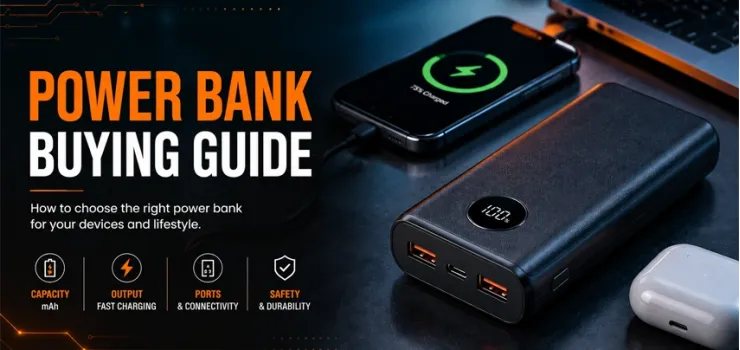
Choosing the right power bank comes down to balancing capacity, speed, and portability. Due to standard energy conversion loss, you receive roughly 60% to 70% of a power bank’s rated mAh as usable power. A 10,000 mAh unit provides 1.5 to 2 full smartphone charges for daily use, while a 20,000 mAh+ model is better for multi-day power outages. Fast-charging speed depends on the wattage (W) and supported protocols, such as Power Delivery (PD). Smartphones need 18W to 30W for fast charging, whereas laptops require a PD power bank outputting 45W or higher over USB-C.
Prioritize built-in circuit protection and buy from an authorized power bank seller with official warranties to ensure safe, reliable performance.
Let's explore what mAh and watts actually mean, how much capacity your devices need, and how to spot a fake power bank before it damages your phone.
mAh vs. Watt - What Each Number Actually Tells You
These two numbers answer two completely different questions. mAh (milliamp-hour) tells you how much energy the power bank stores, which determines how many times it can charge your phone.
Watt (W) tells you how fast that energy flows out, so it decides how quickly your phone actually charges.
Think of mAh as the size of a water tank and watts as the size of the pipe. A huge tank with a thin pipe still slowly fills your glass.
A 30,000mAh power bank with only a 10W output will charge your phone at the same crawling pace as an old 10,000mAh unit.
Why your power bank never delivers its full rated capacity
A power bank's battery cells run at 3.7V, but your phone needs 5V to charge. Converting that voltage wastes energy as heat, and the internal circuitry uses a bit more on top of that. In practice, a 10,000mAh power bank never actually pushes 10,000mAh into your phone.
The real formula: rated mAh × 0.6–0.7 = usable capacity
A simple way to estimate real-world output is to multiply the rated mAh by 0.6-0.7. So a 10,000mAh power bank realistically delivers 6,000 to 7,000mAh to your device, not the full 10,000mAh printed on the box. Keep this in mind whenever a seller promises ‘full charge guaranteed’ capacity, because physics does not allow it.
How Many mAh Do You Actually Need?
Match the power bank to your actual phone battery and daily habits, not the biggest number on the shelf.
The most common decision buyers face is between 10,000mAh and 20,000mAh power banks: the 10,000mAh size wins on pocketability for single-phone daily use, while the 20,000mAh size wins if you need multiple charges or you're charging more than one device.
For everyday smartphones (Android and iPhone)
Most Android phones sold in Bangladesh now ship with 5,000mAh batteries, and iPhones range from around 3,300mAh to 4,400mAh depending on the model.
That gap matters when you're comparing a power bank for iPhone vs. Android use: iPhone owners get slightly more charges from the same power bank simply because the iPhone's battery is smaller.
For a phone in either camp, a 10,000mAh power bank like the Awei P168K 10000mAh 22.5W or Vention FHKB0 10000mAh comfortably gives you one and a half to two extra charges.
For budget phones common in Bangladesh
Entry-level phones with smaller 3,000 to 4,000mAh batteries do not need a massive power bank. A basic 10,000mAh unit, such as the Fantech S2 10000mAh or the compact Delux MP02 6000mAh, covers a full day of backup without adding much weight to your bag.
For tablets and iPads
Tablets have larger batteries, usually 7,000 to 10,000 mAh, so a 20,000 mAh power bank is the practical minimum if you want even one full top-up. Look for models with at least 18W output so the tablet actually charges at a usable speed instead of trickling.
For laptops - why capacity alone isn't enough
This is where most buyers go wrong. Laptops don't just need a high mAh number; they need enough wattage to match their charging port. A 20,000mAh power bank with only 10W output will not charge a laptop at all, no matter how large the battery is.
For laptop charging, you need a ‘Power Delivery’ power bank rated at 45W or higher, such as the UGREEN PB205 25000mAh 145W or the Verbatim VAPPP110 20000mAh 100W.
In our hands-on testing with the UGREEN PB205 plugged into the 100W USB-C1 port, it took an M1 MacBook Air from 20% to 80% in roughly 38 minutes while actively browsing and working. The power bank stayed comfortably cool throughout, leaving over 60% on its digital screen for subsequent phone charges.
Fast Charging Explained: PD, QC, and What Your Phone Actually Supports
Fast charging only works if both the power bank and your phone support the same protocol. A power bank labeled "65W fast charging" will not charge your phone any faster than a basic model if your phone caps out at 18W.
Power Delivery (PD) vs Quick Charge (QC) - do they matter for your phone?
Power Delivery (PD) is the universal fast-charging standard used across iPhones, most Android phones, tablets, and laptops through USB-C. Quick Charge (QC), developed by Qualcomm, is common on Android phones with Snapdragon chipsets.
You may also see SCP (Super Charge Protocol) on Huawei and Honor devices, which works the same way but is proprietary to that brand. A useful fast-charging power bank for Bangladesh usually supports PD, QC, and SCP, so it works with any phone you or your family members own.
You must check your phone's own charging spec sheet rather than chasing the highest wattage number on the power bank box.
Matching wattage to your device
Which Power Bank Fits Your Situation
Matching the right power bank to your routine requires balancing daily portability against your total energy needs, whether you need a pocket-sized 5,000mAh model for quick phone top-ups, a 10,000mAh unit for everyday travel, or a high-wattage 20,000mAh+ pack for multi-device laptop power.
Students and daily commuters
A slim 10,000mAh power bank with 18-22.5W fast charging is the sweet spot. It fits in a backpack side pocket, adds minimal weight, and covers a full day of classes or office commuting without needing a top-up.
Frequent load-shedding households
If your area still deals with unpredictable power cuts, capacity matters more than slimness. When people ask what the best power bank collection for load shedding in Bangladesh is, the honest answer is not the slimmest or cheapest option; it's the one with the highest realistic capacity you can comfortably carry.
A 20,000 to 30,000mAh power bank, such as the Vention FHLB0 20000mAh or Remax RPP-596 Fluorite Series 40000mAh, can keep a phone, router, and a small lamp running through several hours of load shedding without a wall outlet.
Pair it with a WiFi router UPS if internet uptime during outages matters for work-from-home.
Travelers - airline carry-on limits (100Wh / ~27,000mAh) explained
Airlines generally cap carry-on power banks at 100Wh, not directly by mAh. Since watt-hours equal mAh × voltage divided by 1,000, a power bank rated at 3.7V hits the 100Wh limit at roughly 27,000mAh.
That means a 30,000mAh or 40,000mAh power bank may be refused at airport security, even though it looks similar in size to a 27,000mAh model.
Note that some airlines allow power banks between 100Wh and 160Wh (around 27,000 to 43,000mAh) if you request approval prior to boarding. If you fly often without prior clearance, stay at or below 27,000mAh, or check the exact Wh rating printed on the device before you pack.
Charging multiple devices at once
If you regularly charge a phone, earbuds case, and smartwatch together, prioritize a power bank with three or more output ports and enough total wattage to cover all of them at once, not just one high-speed port.
Models like the Vention FHPB0 20000mAh with four output ports handle this well.
Features Worth Paying For (and Ones That Aren't)
Investing in high-speed Power Delivery, multiple output ports, and reliable circuit protection adds real daily value, while overpaying for inflated capacity claims, built-in cables, or unnecessary solar add-ons often leads to wasted money.
USB-C input/output and LED percentage displays
USB-C input lets you recharge the power bank itself faster, which matters during short load-shedding windows. A digital LED display showing the exact battery percentage is helpful, since single-LED indicators only give you a rough guess at 25% jumps.
Overcharge, short-circuit, and temperature protection
These are not optional extras. Any power bank you buy should have overcharge protection, short-circuit protection, and temperature control built in. Reputable brands stocked at EERNA include this as standard, and it is one of the clearest signs you're buying a genuine unit.
Features that sound good but rarely help
Flashing RGB lights, built-in flashlights, and oversized battery percentage animations look impressive in marketing photos but add little real value. They also drain extra power and add cost. Spend that money on capacity or wattage instead.
How to Spot a Fake or Unsafe Power Bank in Bangladesh
Protecting your devices starts with recognizing red flags like suspiciously low prices, mismatched capacity-to-weight ratios, and missing official warranty seals from authorized local distributors.
Capacity claims that are physically impossible
If a power bank claims 50,000mAh but weighs less than a phone, be suspicious. Real lithium-ion cells have a known energy density, so a genuine 50,000mAh power bank is necessarily heavy and bulky. Extremely cheap "power banks" claiming huge capacities at very low prices are almost always mislabeled or fake.
Missing certifications and warranty documentation
For proper power bank safety certification, look for CE, FCC, and RoHS marks on the box or the unit itself; they are your first clue that a manufacturer has actually tested the cells rather than just printed a number on the packaging. Genuine power banks come with these certification labels alongside manufacturer warranty documentation.
Buying from an unauthorized street vendor without warranty paperwork or certification marks means you have no recourse if the unit overheats or damages your phone.
Trusted seller like EERNA sells 100% genuine, officially warrantied power banks with 6 to 12 months of coverage on most models, which is the safest way to buy in Bangladesh.
Power Bank Safety and Battery Care
Properly maintaining your power bank, by avoiding extreme heat, preventing complete battery drains, and using high-quality cables, ensures optimal charging performance and extends its overall lifespan.
Ideal charge range (20–80%) and why full discharge cycles shorten lifespan
Lithium-ion batteries last longest when kept between 20% and 80% charge. Repeatedly draining a power bank to 0% and charging it back to 100% stresses the cells and shortens their usable lifespan more quickly than partial-charge cycles.
Heat, storage, and long-term care
Store your power bank in a cool, dry place away from direct sunlight. Bangladesh's heat and humidity accelerate battery degradation, so avoid leaving it in a car dashboard or a bag left in direct sunlight.
If you are not using it for a few weeks, store it at roughly 50% charge rather than fully charged or fully drained.
Final Thoughts: Choosing With Confidence
The mAh number on the box is only half the story.
Filter your choice by wattage first, then pick the maximum weight you are comfortable carrying daily.
As long as you match your device’s fast-charging protocol and buy a certified model with an official local warranty, you will get optimal performance without risking battery health.
Don't miss browsing the full range at EERNA's power bank category to compare verified prices and warranty details before you buy.
Frequently Asked Questions
Can a power bank charge my laptop?
Yes, but only if it supports Power Delivery (PD) at 45W or higher and your laptop charges over USB-C. A standard 10W or 18W power bank will not charge most laptops.
Is it safe to charge my phone overnight using a power bank?
Most modern power banks have overcharge protection that shuts off the power once your phone is full, so they are generally safe. Still, unplugging once your phone reaches 100% is better for long-term battery health.
How long does a power bank last before it wears out?
Most lithium-ion power banks retain good performance for around 300 to 500 full charge cycles, roughly 1.5 to 3 years of regular daily use, before capacity noticeably drops.
Should I discharge my power bank fully before recharging?
No. Full discharge cycles actually shorten battery lifespan. Keeping it between 20% and 80% charge whenever possible is better for long-term health.
Do I really need PD or QC fast charging?
Only if your phone or laptop supports it. Check your device's charging specs first, since fast charging on the power bank does nothing if your device caps out at a lower wattage.
What's the actual difference between mAh and watts?
mAh measures how much energy the power bank stores, which determines how many charges you get. Watts measure how fast that energy is delivered, which determines charging speed.
How many mAh of power bank do I need for a 4,000–5,000 mAh phone battery?
A 10,000mAh power bank is the practical minimum, giving you roughly one and a half to two full charges after accounting for real-world efficiency loss.
How can I tell if a power bank sold in Bangladesh is fake?
Check for unrealistic capacity-to-weight ratios, missing certification labels, and the absence of an official warranty. Buying from an authorized retailer like EERNA protects you from counterfeit units.


-330x240.webp)



Comments
There are no comments for this Article.