



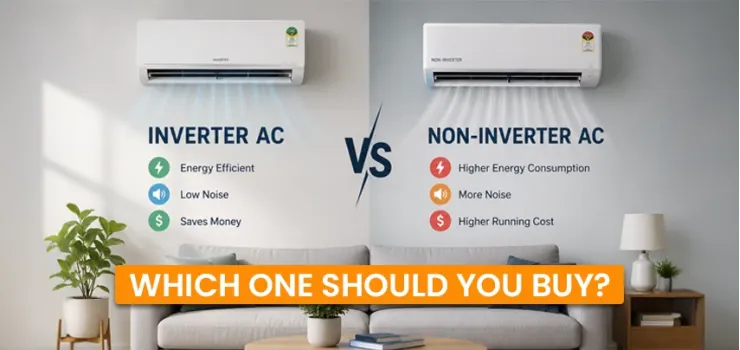
Buy an inverter AC if you run it more than 6 hours per day. An inverter AC of 1.5 tons costs ৳700 to ৳1,500 less per month in electricity than a non-inverter model of the same capacity. Over a year, that saving reaches ৳8,400 to ৳18,000, which recovers the higher purchase price within 2 to 3 years. Non-inverter AC still makes sense for rooms used occasionally, such as a guest bedroom, which is switched on a few times per week. For daily use across Bangladesh's long, hot April to October season, inverter technology is the financially smarter and more comfortable choice. Today, we discuss how inverter ACs work, a real electricity cost comparison using current BPDB rates, how load shedding affects both types, and top brand recommendations for every budget. Every AC listed is available at EERNA with an official warranty and after-sales support.
The question of inverter vs. non-inverter ACs comes up every time someone shops for an air conditioner in Bangladesh.
The showroom price difference is real, making non-inverter models tempting. But the total cost of ownership across three to five years tells a very different story.
This guide breaks down exactly what the difference is, what it means for your monthly electricity bill, and which type makes the most financial sense for how you actually use your AC in Bangladesh.
All prices and brand recommendations in this guide are based on products currently available at EERNA's AC store, Bangladesh's trusted source for officially imported air conditioners with full warranty coverage.
Inverter vs Non-Inverter AC: Key Differences at a Glance
The table below gives you every important difference between inverter and non-inverter ACs in one place. Use it as your quick decision tool before reading the full breakdown below.
Inverter AC costs more upfront but saves money every month it runs. Non-inverter AC is cheaper to buy but more expensive to own over time.
How Does an Inverter AC Actually Work?
Most buyers hear the word inverter and assume it relates to power backup. It does not. The inverter in an AC is a variable-speed drive in the compressor, the part of the AC that actually produces cold air. Here is the plain-language explanation.
What is an Inverter Compressor?
An inverter compressor is a motor with variable speed that is used in appliances such as air conditioners and refrigerators. It adjusts its cooling speed based on demand instead of switching on and off like traditional compressors.
An inverter compressor can run at different speeds. When you first turn the AC on, and the room is very hot, it runs at high speed to cool the room down quickly.
Once the room reaches your target temperature, instead of switching off completely, it slows down to a low speed that just maintains the temperature.
It is exactly how a car's cruise control works. Instead of accelerating and braking repeatedly, you maintain a steady, efficient speed.
The result is dramatically lower electricity consumption, less wear on the compressor motor, and quieter operation.
Inverter compressors also respond more precisely to temperature changes, keeping the room at a more comfortable, stable temperature rather than swinging between too cold and too warm.
How a Non-Inverter AC Works by Comparison
A non-inverter AC has a compressor that operates at full power. It switches on at maximum capacity, runs until the room hits the target temperature, then shuts off completely.
When the room warms up again, it switches back on at full power. This constant cycle of maximum power on and complete off repeats throughout the time the AC is running.
The start-stop pattern consumes significantly more electricity because starting a motor from zero draws a surge of power each time.
It also puts more mechanical stress on the compressor with every restart, which is why non-inverter AC units tend to have shorter service lives than inverter models.
Why it Matters for Your Electricity Bill
In Bangladesh, BPDB residential electricity rates have increased substantially since 2022. As of 2026, most households pay ৳8 to ৳10 per unit (kWh) in the mid-consumption slab.
A non-inverter 1.5-ton AC running at full power draws 1,500-2,000 watts continuously. An inverter model at the same tonnage draws 500-800W during steady-state cooling after the room reaches the target temperature.
Over an 8-hour day and 6 months of Bangladesh's hot season, that difference adds up to tens of thousands of taka.
Electricity Cost Comparison: Inverter vs Non-Inverter AC in Bangladesh
The tables below use real current BPDB residential rates to show the actual monthly and annual cost difference. These are the numbers no other AC article in Bangladesh has shown in this level of detail.
Real Monthly Bill Calculation: Inverter AC vs Non-Inverter
These figures assume typical residential usage in Bangladesh. Actual consumption varies with room insulation quality, number of windows, floor height, and local voltage quality. The direction of the saving, however, is consistent, meaning inverter models always use substantially less electricity for the same cooling output.
When Does Inverter AC Pay for Itself?
The payback period depends on how many hours per day you run the AC. The table below shows the estimated payback across different usage levels, based on an average price premium of ৳15,000 to ৳20,000 for an inverter model over a comparable non-inverter unit.
If you use your AC 8 hours per day through Bangladesh's April to October hot season (approximately 7 months), you save enough on electricity to recover the inverter premium within 1.5 to 3 years. Everything after that is pure saving.
Inverter AC vs Non-Inverter: Which Is Better for Bangladesh's Climate?
Bangladesh's climate creates specific conditions that affect AC performance in ways that general buying guides written for other countries do not cover. Here is what matters locally.
Performance in Extreme Heat (38 to 42 Degrees Celsius in Dhaka Summer)
During April and May in Dhaka, outdoor temperatures regularly reach 38 to 42 degrees Celsius. At these temperatures, an AC's compressor operates at or near maximum capacity, regardless of whether it's an inverter or non-inverter type.
The efficiency gap between the two narrows slightly during peak summer heat, because even an inverter compressor runs at near full speed when cooling against such high outdoor temperatures.
However, once the room reaches the target temperature in the late evening when outdoor temperatures drop to 28 to 32 degrees, the inverter compressor slows down.
The non-inverter keeps cycling on and off at full power. It is when the energy savings are most pronounced, making the inverter AC significantly more efficient during the longer, cooler overnight hours.
How Load-Shedding Affects Inverter vs Non-Inverter AC
Load shedding is a real concern for AC buyers across Bangladesh outside Dhaka's central grid areas.
When power returns after a load-shedding cut, both AC types restart. The non-inverter compressor restarts at full power, drawing a large current surge that can stress the motor and the household wiring. Repeated restarts like this accelerate compressor wear in non-inverter units.
An inverter AC restarts more gradually, ramping up compressor speed from a lower starting point.
The gentler restart draws less surge current, puts less stress on the motor, and is less likely to trip circuit breakers after power returns.
Inverter ACs also generally incorporate better voltage protection circuitry, making them more resilient to the voltage fluctuations that often accompany power restoration in Bangladesh.
Cooling Performance in High Humidity (Monsoon Season)
Bangladesh's monsoon season, from June to September, brings extremely high humidity and heat.
AC units cool the air and simultaneously remove humidity through condensation on the evaporator coil.
An inverter AC running continuously at low speed removes humidity more steadily and consistently than a non-inverter unit that switches on and off.
When a non-inverter AC switches off, the evaporator coil warms up, and some moisture re-evaporates back into the room air.
An inverter AC running at a low, continuous speed keeps the coil cold and continuously removes humidity.
The result is a more comfortable indoor environment during monsoon season, not just cooler but also noticeably drier and less sticky.
Inverter AC Pros and Cons for Bangladesh Buyers
Here is an honest assessment of inverter AC for Bangladesh buyers in 2026, including the limitations that sellers often skip over.
Non-Inverter AC Pros and Cons
Non-inverter AC is not the wrong choice for every buyer. Here is when it makes sense and where it falls short.
Best Inverter ACs Available in Bangladesh: Our Top Picks
All brands below are officially imported, widely stocked, and have service networks in Bangladesh. Browse the complete AC range at EERNA for current stock and live pricing.
Best Overall: Gree Fairy Series Inverter AC
Gree is the world's largest AC manufacturer by production volume and one of the most popular inverter AC brands in Bangladesh.
The Gree Fairy Series offers strong energy efficiency ratings, reliable cooling down to minus 15 degrees Celsius, and a 5-year compressor warranty.
Gree has authorized service centers in Dhaka, Chittagong, Sylhet, Rajshahi, and other divisional cities.
For most Bangladesh buyers, Gree inverter AC offers the best combination of price, efficiency, and after-sales coverage.
Best Value Inverter AC: Midea Mission Series
Midea's Mission Series inverter AC is the best option for buyers who want reliable inverter technology at the most accessible price in Bangladesh.
Starting at around ৳46,000 for a 1.5-ton unit, it offers genuine inverter-compressor performance with a solid energy-efficiency rating.
Midea has significantly expanded its service network in Bangladesh since 2023. For first-time inverter AC buyers or secondary rooms,
Plus, Midea delivers excellent value without cutting corners on the core inverter technology. Browse Midea AC at EERNA.
Best Local Brand: Walton Inverter AC Review
Walton is Bangladesh's leading domestic appliance brand and the best choice for buyers who prioritize nationwide service access above all else.
Walton has service centers across all 64 districts of Bangladesh, meaning repair support is available even outside major cities.
Walton 1 Ton Inverter AC (Split Type WSI-RIVERINE-12F) starts at around ৳50,000 for a 1.5-ton and delivers honest inverter performance with good energy ratings.
Build quality has improved noticeably over the last three years. For buyers in smaller cities and rural areas, Walton's service reach is unmatched.
Quick Comparison of Top Inverter AC Picks Available in Bangladesh
Other quality brands available at EERNA include General, Samsung, Haier, Hisense, Panasonic, Sharp, Singer, Elite, Smart, Super General, and Xiaomi inverter AC models. Browse now.
AC Buying Guide: What Else to Consider Before You Buy
Choosing between an inverter and a non-inverter is the most important decision, but three more factors determine whether your AC purchase will serve you well for years.
What Tonnage Do You Need? (Room Size Guide)
Tonnage refers to an AC's cooling capacity. Too small, and the AC runs constantly without cooling the room.
Too large and you overspend on both the unit and electricity. The table below is calibrated for Bangladesh's climate, which runs warmer and more humid than standard international calculations assume.
If your room sits at the upper end of a size range, choose the next tonnage up. A 145 sq ft room is technically within the 1 ton bracket, but a 1.5 ton inverter unit will cool it faster and more comfortably in Bangladesh's extreme summer heat.
Star Rating and Energy Efficiency in Bangladesh
Energy efficiency labels on ACs in Bangladesh use either an EER (Energy Efficiency Ratio) or ISEER (Indian Seasonal Energy Efficiency Ratio) scale.
A higher number means better efficiency. For inverter ACs, look for an ISEER of at least 4.0. For a non-inverter, a minimum EER of 2.8. Some premium inverter models from Gree, General, and Panasonic achieve ISEER ratings of 5.0 or higher, further reducing monthly electricity costs beyond the standard inverter savings.
Bangladesh does not yet have its own mandatory Energy Star labeling system equivalent to India's BEE rating.
However, most imported brands carry the energy rating from their country of origin, which is a reliable guide to comparative efficiency.
Voltage Stabilizer: Do You Need One in Bangladesh?
Most modern inverter ACs include built-in voltage protection that handles a range of 150V to 264V, which covers most Bangladesh residential voltage fluctuations.
Check the AC's specification sheet for its operating voltage range. If your unit's voltage tolerance matches the quality of your local supply, a separate stabilizer is not strictly necessary.
However, areas with severe or frequent voltage fluctuations, particularly outside Dhaka's central grid, benefit from an additional external stabilizer as a protective layer.
A good quality servo stabilizer costs ৳5,000 to ৳12,000 and can prevent compressor damage that would cost far more to repair.
Ask the EERNA team for a recommendation based on your area's voltage conditions.
Frequently Asked Questions on Inverter vs Non-Inverter AC in Bangladesh
Is an inverter AC better than a non-inverter AC in Bangladesh?
Yes, for daily use. Inverter ACs use 30 to 50 percent less electricity, run quieter, last longer, and handle Bangladesh's load-shedding restarts more safely than non-inverter models.
How much electricity does an inverter AC save in Bangladesh?
At 8 hours of daily use, a 1.5-ton inverter AC saves ৳700 to ৳1,500 per month compared to a non-inverter AC. Annual savings reach ৳8,400 to ৳18,000 at current BPDB rates.
What is the price difference between an inverter and a non-inverter AC?
Inverter 1.5-ton ACs start at around ৳42,000 to ৳52,000. Non-inverter 1.5 ton models start at ৳28,000 to ৳35,000. The upfront premium is ৳12,000 to ৳20,000 on average.
Which AC brand is best in Bangladesh?
Gree offers the best overall value. General leads on durability. Samsung excels in smart features. Walton has the widest service network across all 64 districts. Browse all brands at EERNA's AC page.
What happens to an inverter AC during load-shedding?
An inverter AC restarts more gradually after load shedding, drawing less current surge than a non-inverter AC. It is more resilient to repeated restarts and handles Bangladesh's voltage fluctuations better overall.
What size AC do I need for a 150 sq ft room in Bangladesh?
A 150 sq ft room needs a 1.5 ton AC in Bangladesh's climate. If the room faces west, gets direct sun, or is on the top floor, a 1.5-ton inverter model is still correct but will perform better than a 1-ton unit.
Does an inverter AC need a voltage stabilizer in Bangladesh?
Most inverter ACs have built-in voltage protection for 150V to 264V. A separate stabilizer is optional for central Dhaka but recommended in areas with severe voltage fluctuations outside major city grids.





-330x240.webp)




Comments
There are no comments for this Article.