





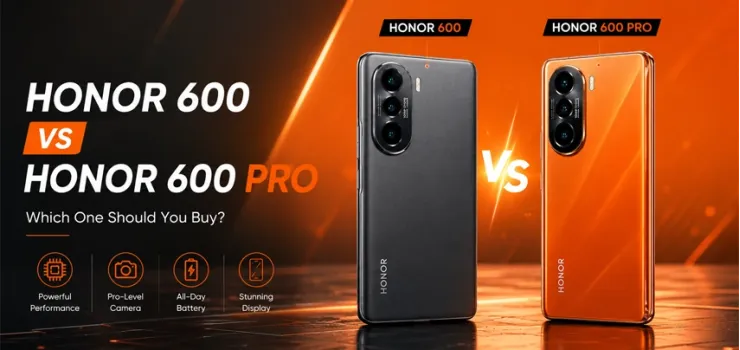
The main differences between the Honor 600 and the Honor 600 Pro are the processor, telephoto camera, and wireless charging support.
The standard Honor 600 uses a Snapdragon 7 Gen 4 chip, lacks a dedicated zoom lens, and supports only wired charging, while the Pro model upgrades to a flagship Snapdragon 8 Elite chip, adds a 50MP 3.5x optical telephoto camera, and includes 50W wireless charging.
Both devices share an identical 6.57-inch AMOLED 120Hz display, a 200MP main sensor, and a robust IP68/IP69K durability rating.
Picking between two phones that look nearly identical on paper is harder than picking between two that are obviously different.
You already know you want an Honor smartphone. The problem is figuring out whether the Pro's extra cost buys you something you'll actually use, or whether you'd be paying flagship money for features that sit unused in a menu somewhere.
That confusion gets expensive fast, especially with a price gap that can run into tens of thousands of taka.
Get the choice wrong and you either overpaid for a zoom lens you never open, or underbought and now wish you had faster wireless charging on your desk.
This guide walks through every spec that actually changes between the two models, what Bangladeshi buyers pay for each, and which one fits your daily habits.
Honor 600 vs Honor 600 Pro at a Glance
Both phones share the same display, main camera, and battery capacity, which means the price difference comes down to a short list of components: the chipset, the telephoto lens, and wireless charging.
Everything else you interact with daily stays the same across both models.
GSMArena's own head-to-head comparison confirms this pattern directly, noting that the two phones share "the same flagship-grade display, same battery capacity, same main camera and 80W fast wired charging."
That overlap is exactly why this comparison matters. Once you know what's shared, the buying decision gets a lot simpler.
Price Gap in Bangladesh
The Honor 600 Pro's 12GB/256GB variant carries an official Bangladesh launch price of BDT 99,999, while grey-market units have appeared for around BDT 77,000.
The standard Honor 600 is available through the Honor 600 12GB/256GB product page on Eerna at BDT 69,999, putting the total gap between the two models somewhere between BDT 20,000 and BDT 35,000 depending on where you buy.
The Honor 600 Pro officially launched in Bangladesh on May 7, 2026.
Grey-market or unofficial units of the same model create a savings gap of roughly BDT 20,000 to 23,000 against the official price, though these units typically skip local warranty coverage.
Globally, GSMArena notes the Pro "costs nearly twice as much as the vanilla model" in some markets.
That's a steep multiplier for a phone that shares most of its core hardware with its cheaper sibling, which is exactly the tension this comparison is built to resolve.
What's Identical Between the Two Models
Despite the price gap, the overlap in specifications between these two phones is substantial. Here's everything that stays exactly the same regardless of which model you choose.
What Actually Changes When You Pay More
Once you strip away everything that's identical, the real upgrade list on the Pro is shorter and more specific than most marketing copy suggests.
The chipset, RAM, and storage generation matter for performance-hungry users.
The telephoto lens and wireless charging matter for photography and convenience. The screen you stare at all day, the main camera you use for most of your shots, and the battery that decides how often you charge stay unchanged.
Design and Build Quality
Honor kept the external design language nearly identical across both models, which makes sense given how much shared hardware these two phones carry.
Composite Fibre Back and Matte Metal Frame - Is Either Model Glass?
Sources genuinely disagree on the back panel material, so it's worth flagging rather than glossing over.
Some Bangladesh retail listings describe the back panel using terms associated with Gorilla Glass protection, while other build-quality breakdowns describe a composite fibre or matte finish paired with a metal frame.
Rather than asserting one definitive material, it's more accurate to say conflicting descriptions exist across sources.
If build material matters to you for grip, durability, or aesthetics, check the exact unit specifications at the point of purchase, since regional variants can differ.
Weight, Dimensions and IP68/IP69K Rating
Physically, the two phones are nearly twins in size but not in weight.
Both measure 156 x 74.7 x 7.8mm, while the Pro is noticeably heavier at 200g against the standard model's 190g, likely due to the added telephoto module and larger wireless charging coil.
Durability sees no compromise on the cheaper model.
Both phones carry the same IP68/IP69/IP69K rating, meaning identical protection against dust, water immersion, and high-pressure water jets, which matters during Bangladesh's monsoon season.
Colour Options Available in Bangladesh
Both models ship in the same three colourways for the Bangladesh market: Black, Golden White, and Orange.
Colour preference alone won't push you toward either model. The choice comes down entirely to the functional differences covered below.
Display: Why the Cheaper Model Doesn't Lose Anything Here
The standard Honor 600 matches the Pro's display specs exactly, so screen quality gives you no reason to pay more.
This is the one component where Honor genuinely gave the cheaper phone flagship treatment without compromise.
Same 6.57-Inch AMOLED Panel, Same 8000-Nit Peak Brightness
Both phones use an identical 6.57-inch AMOLED panel with a 2728 x 1264px resolution, roughly 458 ppi, a 120Hz refresh rate, and 8000-nit peak brightness.
GSMArena's comparison cites this parity as one of the strongest reasons the standard 600 "gets you a long way at a much lower cost."
In daily use, you'd struggle to tell which model you're holding just by looking at the screen.
Good to know: Peak brightness figures like 8000-nit are lab measurements under specific conditions, not what you'll see at every moment outdoors.
Real-world outdoor visibility depends on ambient light and screen coating too.
When LTPO on the Pro's Refresh Rate Actually Shows Up
One website claims the Honor 600 Pro has LTPO technology on its screen, but this doesn't match what other sources say, so it's worth treating with caution.
LTPO is a smart screen technology that changes its refresh rate on its own.
A high refresh rate makes scrolling look smooth, but it also drains battery faster. LTPO screens slow down on their own when you're just reading a text message, then speed back up when you're scrolling fast or gaming.
If the Pro really had this feature and the standard Honor 600 didn't, it would likely last longer on a single charge from screen use alone, which would be a real reason to pay more for it.
But GSMArena's spec sheet, a detailed regional launch breakdown, and Honor's own spec page all describe both screens the same way.
None of them mention LTPO on either phone. Since three separate sources disagree with the one claim, it's safer to treat LTPO as unconfirmed rather than a real difference between the two phones.
If you see it mentioned elsewhere, read it as one site's claim, not a proven spec.
Display & Audio: What Nobody Else Compares
Screen specs get all the attention in most comparisons, but sound quality and connectivity matter just as much if you use your phone for media or gaming.
Speaker Loudness and Codec Support
Audio performance between the two models is nearly indistinguishable for everyday use.
Both support the same premium codec suite, including LDAC, LHDC, aptX HD, Lossless, and Adaptive, meaning wireless audio quality with compatible headphones sounds identical regardless of which model you pick.
Independent loudness measurements show only a marginal gap between the two speaker setups, well within a range most listeners wouldn't notice in blind testing.
Do You Need Bluetooth 6.0?
The Pro steps up to Bluetooth 6.0 with lower latency, while the standard Honor 600 runs Bluetooth 5.4.
This is the one connectivity upgrade genuinely worth knowing about before you decide.
If you're a competitive mobile gamer using wireless earbuds and care about audio-visual sync during matches, the Pro's Bluetooth 6.0 offers a genuine, if modest, edge.
For everyday music, calls, and video streaming, both phones sound and connect the same way.
Performance: Snapdragon 7 Gen 4 vs Snapdragon 8 Elite
This is where the two phones diverge the most, and where the price gap starts to make sense. The Pro's chipset targets sustained, demanding workloads, while the standard model handles everyday tasks without any noticeable lag.
Benchmark Gap Explained in Plain Terms
The Honor 600 Pro has a stronger processor called the Snapdragon 8 Elite.
The Honor 600 has a good processor too, called the Snapdragon 7 Gen 4, but it is a step below the Pro's chip.
Think of it like two students doing the same easy homework. Both finish it fast with no problems.
That is what happens when you browse social media, watch videos, or scroll through apps. Both phones handle this smoothly, so you will not notice a big difference here.
The real test comes with hard, long tasks.
Picture running for an hour without stopping instead of a quick sprint. The Snapdragon 8 Elite stays cool and fast even after a long gaming session or while editing a big video.
The Snapdragon 7 Gen 4 can slow down a bit once you push it that hard for that long.
So the benefit is simple.
If you game for hours or edit videos on your phone often, the Pro's chip keeps up better under pressure. If you mostly text, scroll, and stream, the standard Honor 600 already gives you everything you need.
Who Actually Needs the Pro's Chipset
Independent reviewers frame this distinction consistently.
One detailed comparison notes the standard Honor 600 "is great for action snaps and portraits" and handles daily use comfortably, while "hardcore mobile gamers will be better suited by the Honor 600 Pro, with its upgraded tech."
If your phone usage revolves around messaging, social media, photography, and casual browsing, the performance gap between these two chipsets will rarely be something you notice.
What we consistently see with flagship-tier chips like this is that the real-world gap only shows up under sustained load, not in day-to-day tapping and scrolling.
RAM, Storage Ceiling, and Storage Generation
RAM and storage speed matter just as much as the chipset, and most comparisons skip this part.
The Honor 600 comes with 8GB of RAM and up to 256GB of storage using the UFS 3.1 standard.
Honor 600 Pro steps up to 12GB of RAM and up to 512GB of storage using the newer UFS 4.0/4.1 standard.
More RAM means your phone can hold more apps open at once without slowing down or restarting them.
The storage upgrade matters even more. UFS 4.0 moves data much faster than UFS 3.1, so apps open quicker, big files like videos copy faster, and 4K footage saves to your phone smoothly while you record instead of lagging behind.
Same AI Features, Different Speed
Here's a common misconception worth correcting directly.
Many comparisons frame Honor's AI suite as Pro-exclusive, but that isn't accurate.
According to Honor's own official product page, features like AI Image-to-Video 2.0, AI Photo Agent, Deepfake and Voice Detection, and the bundled 3-month Google AI Pro/Gemini trial are available on both the Honor 600 and the Honor 600 Pro.
The Pro's more powerful chipset simply processes these AI tasks faster.
Generating an AI video or running photo analysis completes quicker on the Pro, but the standard 600 has access to the exact same feature set, not a stripped-down version.
Camera Comparison: Where the Telephoto Lens Earns Its Keep
Cameras often decide phone purchases, and this is genuinely the area with the clearest, most justifiable upgrade path on the Pro.
Main 200MP Sensor - Identical Hardware, Different Stabilization Tier
Both phones use the same 200MP main camera, so photo quality from the main lens is equal on both models.
The real difference is hidden in a technical rating called CIPA, which measures how well a camera fights blur from shaky hands.
The standard Honor 600's main camera scores CIPA 6.0. The Honor 600 Pro's telephoto camera scores CIPA 6.5, which means it can handle shakier hands and still keep shots sharp.
This upgrade only applies to the Pro's zoom camera, not its main camera.
So it matters only when you use the 3.5x zoom, like taking a photo of something far away or a portrait shot.
In that moment, the Pro's steadier zoom camera gives you sharper, less blurry photos than you'd get by zooming in on the standard Honor 600.
Default Focal Length Differs Even on the "Same" Camera
Even with identical main camera hardware, the two phones process images differently by default.
The standard Honor 600 defaults to a 27mm equivalent focal length, while the Pro defaults to a native 24mm focal length.
This means photos taken at 1x zoom will show slightly different framing and colour saturation between the two phones.
Hands-on reviewers comparing shots side by side confirmed this detail, and it's one most spec-sheet comparisons miss entirely because it's a software processing choice rather than a hardware spec.
The Honor 600 Pro's 50MP 3.5x Telephoto
This is the headline camera upgrade, and the most tangible reason to consider paying more.
The Pro includes a dedicated 50MP, f/2.8, 3.5x optical telephoto lens that's completely absent from the standard Honor 600.
One detailed camera comparison found that while "the main camera, ultra wide camera, and selfie camera deliver very similar results" between both phones, "the HONOR 600 Pro does have some important advantages," specifically citing "an extra 3.5x optical zoom camera for more flexibility."
If you frequently shoot distant subjects, portraits with background compression, or travel photography where zoom matters, this is the single strongest argument for the Pro.
Camera App Software Gap: Motion Capture, EV Control, Focus Lock
The Honor 600 Pro also comes with extra camera app tools that the standard model does not have.
It has better motion capture, so fast-moving subjects like kids playing or pets running come out sharp instead of blurry.
It gives you more control over exposure, so you can brighten or darken a photo before you even take it, which helps in tricky lighting like a sunset or a dim room.
It also has focus lock, so you can tap on a subject and the camera stays locked on it, even if the subject or your hand moves a little.
These are not hardware upgrades. They are software features Honor added on purpose to make the Pro feel more capable for photography, on top of the camera parts both phones already share
Selfie Camera and Low-Light Selfie Difference
Both phones use the same 50MP, f/2.0 selfie camera hardware.
Testing found selfie results very similar between the two in good lighting, though the Pro's more capable image processing pipeline can show a modest edge in challenging low-light selfie conditions.
Video Recording - 4K30 vs 4K60 and HDR Vivid
Video capability is a clear-cut Pro advantage.
The standard Honor 600 caps out at 4K resolution at 30fps, while the Pro supports 4K at 60fps, a meaningful difference for anyone shooting fast-motion content, sports, or footage intended for smoother slow-motion editing later.
Night Video Mode - Pro-Only, But Capped at 1080p24
The Pro also includes an exclusive night video mode, but it's worth setting expectations correctly here.
This mode is capped at 1080p resolution and 24fps. It's useful for low-light scenarios, but it isn't a flagship-tier video feature in terms of resolution, so don't expect 4K night video specifically from this addition.
Underwater/Action Shooting - Available on Both
Good news for adventure and action photographers: underwater and action shooting capability is available on both the Honor 600 and Honor 600 Pro, not gated to the more expensive model.
Budget-conscious buyers who want action-camera-style shots don't need to pay extra for this specific use case.
Battery and Charging
Battery life is where this comparison gets genuinely counterintuitive, and where the cheaper phone sometimes has the upper hand.
Same 7000mAh Battery, But Not Quite the Same Number
Both phones say they have a 7000mAh battery, but that number is not fixed.
Honor calls it the "typical" capacity. The real "rated" capacity is closer to 6800mAh, which is the safer, tested number.
Some EU versions of the phone even use a smaller 6400mAh battery, so the number can change depending on where the phone is made.
A bigger typical number sounds good in ads, but the rated number tells you what the battery will actually deliver day to day.
Since Bangladesh units are expected to use the higher-capacity version, buyers here still get strong all-day battery life for calls, video, and social media, without paying extra for it.
Knowing the real number helps you compare phones honestly instead of trusting marketing alone.
Heads up: Bangladeshi buyers should confirm which regional variant they're purchasing, since battery capacity can differ from the headline "7000mAh" figure depending on where the unit was manufactured for.
50W Wireless Charging - Only on the Pro
Wireless charging is a clean, unambiguous differentiator.
The Pro supports 50W wireless charging, while this feature is completely absent from the standard Honor 600's spec page.
Not a slower version, simply not included at all. If wireless charging pads are part of your daily routine, this is a non-negotiable reason to consider the Pro.
The Counterintuitive Result: The Cheaper Phone Often Lasts Longer
Here's the most underreported finding across independent testing, and it deserves to stand on its own rather than get buried as a minor bullet point.
Despite matching battery capacities on paper, multiple independent reviews, including hands-on testing referenced by GSMArena and separate real-world comparisons, found that the standard Honor 600 often outlasts the Pro during typical daily use like browsing and streaming video.
The reason comes down to chipset efficiency.
The Snapdragon 7 Gen 4 in the standard model is less power-hungry during light-to-moderate tasks than the more powerful Snapdragon 8 Elite in the Pro.
The Pro's battery advantage only shows up during sustained gaming sessions, where its more powerful GPU and better thermal management under load let it maintain performance longer.
For the average user who isn't gaming for hours at a time, the standard Honor 600 may actually deliver a full day of use more reliably.
This runs counter to the assumption that more expensive always means better battery life, and it's worth knowing before you pay the premium.
Honor 600 vs Honor 600 Pro Price in Bangladesh
Pricing is ultimately what decides whether any of these hardware differences are worth paying for.
Official Honor BD Pricing Status
Honor's official Bangladesh pricing can shift, and static listings may not always reflect current promotional pricing.
Based on available retail data, the Honor 600 Pro's 12GB/256GB variant is officially priced at BDT 99,999.
Verify current pricing directly through Honor's official channels or authorized retailers like Eerna before buying, since figures can become outdated between research and publication.
Grey-Market vs Authorized Retailer Pricing
Unofficial or grey-market Honor 600 Pro units have been spotted for around BDT 77,000, a savings of roughly BDT 20,000 to 23,000 against the official price.
While tempting, grey-market units typically come without official Bangladesh warranty coverage or authorized service centre support, an important trade-off to weigh against the upfront savings.
EMI Availability Through BD Retailers
Major Bangladesh electronics retailers commonly offer EMI installment options on flagship smartphones in this price range, which can make the Pro's higher upfront cost more manageable for budget-conscious buyers.
Availability and specific EMI terms vary by retailer and bank partnership, so check directly with each platform for current offers at the time of purchase.
Warranty and Service Centre Coverage for Official vs Unofficial Units
Official units purchased through authorized Bangladesh channels typically come with standard manufacturer warranty coverage and access to authorized service centres for repairs.
Grey-market or unofficially imported units generally lack this coverage, meaning any hardware issues would need third-party repair shops instead of official support.
After helping buyers navigate flagship purchases across Bangladesh's grey-market and authorized channels, what we consistently see is that warranty coverage is the deciding factor buyers regret skipping, not the one they think about upfront.
Is the Price Gap Worth It for BD Buyers Specifically?
Weighing the roughly BDT 20,000 to 35,000 price difference against what you actually get, the value case for the Pro comes down to two specific use cases: sustained gaming performance and telephoto zoom photography.
For buyers who fall into neither category, the standard Honor 600 delivers nearly identical daily-use performance, an identical display, the same main camera, and potentially better everyday battery life, all at a meaningfully lower price.
This makes the standard Honor 600 the stronger value pick for most Bangladeshi buyers, with the Honor 600 Pro reserved for a narrower audience.
Who Should Buy the Honor 600?
The standard Honor 600 is the better choice if you fall into any of these categories:
You mainly use your phone for social media, streaming, messaging, and casual browsing
You want battery longevity for typical daily use over gaming performance
You don't need optical zoom and are satisfied with the main, ultrawide, and selfie cameras
You want flagship-level display quality without paying flagship-level prices
Who Should Buy the Honor 600 Pro?
The Honor 600 Pro justifies its premium for a narrower but clearly defined audience:
Mobile gamers who need sustained high performance during extended sessions
Photographers who frequently shoot distant subjects and want genuine 3.5x optical zoom
Anyone who relies on wireless charging as part of their daily routine
Videographers who need 4K60 recording capability that the standard model doesn't offer
Frequently Asked Questions
What is the difference between the Honor 600 and Honor 600 Pro?
The Pro adds a Snapdragon 8 Elite chipset, a 50MP 3.5x telephoto camera, and 50W wireless charging.
Is the Honor 600 Pro worth the extra money?
Only if you game heavily or need optical zoom, otherwise the standard Honor 600 offers nearly the same experience for less.
Does the Honor 600 have a telephoto camera?
No, only the Honor 600 Pro has a dedicated 50MP 3.5x telephoto camera.
Does the Honor 600 support wireless charging?
No, wireless charging is only available on the Honor 600 Pro, at 50W.
Which chipset is better, Snapdragon 7 Gen 4 or Snapdragon 8 Elite?
The Snapdragon 8 Elite in the Pro is the stronger flagship chip, built for sustained, demanding tasks.
What is the Honor 600 Pro price in Bangladesh?
The official 12GB/256GB variant is priced at BDT 99,999.
Is the Honor 600 good for gaming?
It handles casual gaming well, but the Honor 600 Pro is better suited for extended, high-performance gaming sessions.
What is the battery capacity of the Honor 600 and Honor 600 Pro?
Both are marketed with a typical 7000mAh battery, with a rated capacity closer to 6800mAh.



-330x240.webp)



Comments
There are no comments for this Article.